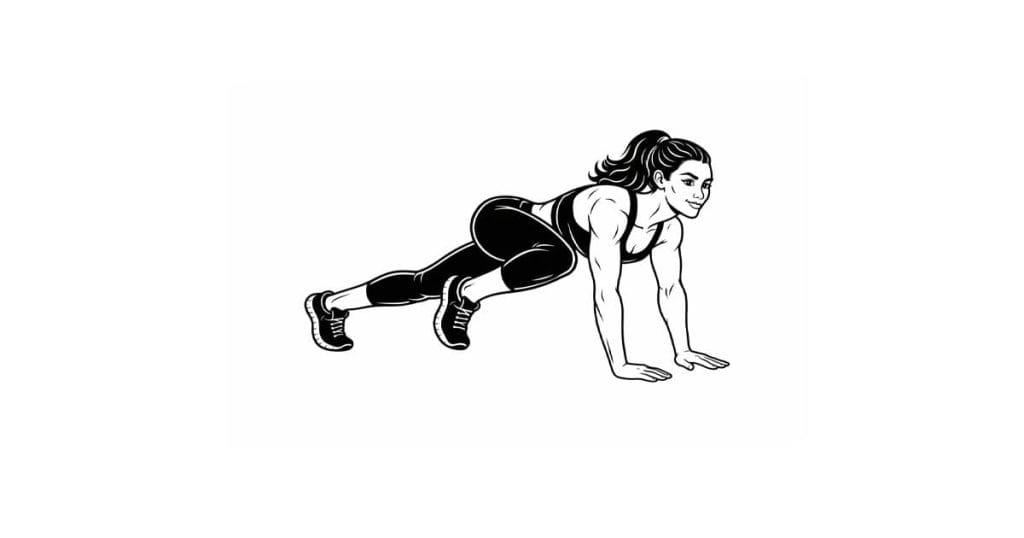
The Stability Ball Elbow Circles is an advanced core stabilization exercise that combines a forearm plank with controlled circular movements on a stability ball. Rather than holding a static plank, you move your forearms in small circles while maintaining a rigid body position. As the stability ball rolls beneath your elbows, your core must resist extension and rotation to keep the spine aligned. This makes the exercise highly effective for developing functional core strength, shoulder stability, balance, and neuromuscular control.
The primary muscle group targeted during the Stability Ball Elbow Circles is the abs and core. The rectus abdominis and transverse abdominis work continuously to prevent the lower back from arching while maintaining a stable plank position. Instead of creating movement through the spine, these muscles resist unwanted motion, making this an excellent anti-extension exercise that develops deep core stability.
Several secondary muscle groups assist throughout the movement. The obliques help resist trunk rotation as the ball moves in circular patterns, while the shoulders, including the anterior deltoids and rotator cuff muscles, stabilize the upper body and control the movement of the ball. The chest and triceps provide additional upper-body support, while the glutes remain engaged to maintain pelvic alignment and keep the body in a straight line from head to heels.
One of the greatest benefits of the Stability Ball Elbow Circles is improved anti-extension core strength. Every circular movement shifts the body’s center of gravity, forcing the abdominal muscles to maintain spinal alignment under constantly changing conditions. This type of strength transfers well to lifting, sports, and daily activities that require a stable trunk.
Another major benefit is enhanced shoulder stability and endurance. The shoulders must continuously stabilize the unstable ball while guiding it through smooth, controlled circles. This improves shoulder control, joint stability, and muscular endurance that can benefit pressing, overhead, and weight-bearing exercises.
The exercise also develops balance, coordination, and proprioception. As the stability ball rolls beneath the forearms, the nervous system must constantly adjust muscle activation to maintain body position. These continuous corrections improve movement quality, body awareness, and overall neuromuscular efficiency.
To perform the Stability Ball Elbow Circles, place your forearms on top of a stability ball and extend your legs behind you into a forearm plank. Position your elbows directly beneath your shoulders and create a straight line from your head to your heels. Brace your core, squeeze your glutes, and maintain a neutral spine before beginning the movement.
Slowly move your forearms in small, controlled circles, allowing the stability ball to roll beneath your elbows while keeping your hips and shoulders as stable as possible. Complete all repetitions in one direction before reversing the circles. Focus on maintaining full-body tension rather than making large or fast movements.
Proper technique is essential for maximizing results. Keep the circles small and deliberate, maintain steady breathing, and avoid allowing your hips to sway or your lower back to arch. Quality movement is far more important than the size or speed of the circles.
Common mistakes include making circles that are too large, moving too quickly, allowing the hips to rock side to side, arching the lower back, shrugging the shoulders, or relaxing the core. These errors reduce abdominal activation and increase stress on the shoulders and lumbar spine. Maintaining a rigid plank position throughout every repetition ensures maximum effectiveness.
From a safety standpoint, the Stability Ball Elbow Circles are best suited for individuals who have mastered a standard forearm plank and possess adequate shoulder and core stability. Beginners should first develop sufficient plank endurance before progressing to this advanced variation. If proper spinal alignment cannot be maintained, reduce the size of the circles or return to a stationary plank.
Overall, the Stability Ball Elbow Circles are an excellent exercise for strengthening the core, improving anti-extension strength, enhancing shoulder stability, and developing better balance and coordination. Their combination of instability and controlled movement makes them a valuable addition to functional fitness programs, athletic conditioning, and advanced core training.