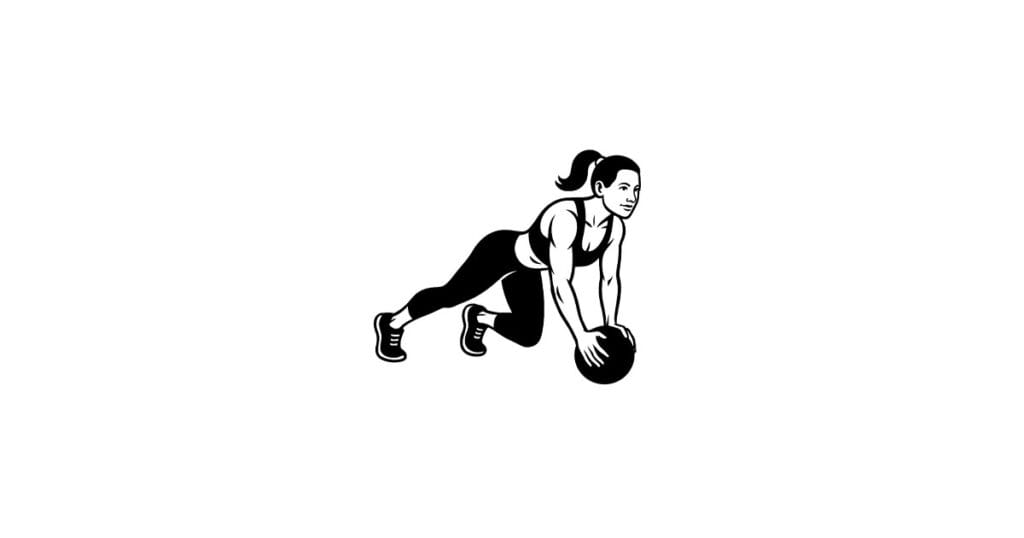
The Stability Ball Rollout is an effective core strengthening exercise that develops abdominal stability, trunk control, and shoulder strength by resisting spinal extension throughout the movement. Unlike traditional abdominal exercises that focus on repeated spinal flexion, the rollout challenges the core to maintain a neutral spine while the arms extend away from the body. Using a stability ball creates a smooth, controlled movement while adding instability that increases activation of the abdominal muscles and stabilizing muscles throughout the torso. This makes the exercise an excellent choice for improving functional core strength, posture, and total-body control.
The primary muscle group targeted during the Stability Ball Rollout is the abs and core. The rectus abdominis and transverse abdominis contract isometrically to prevent the lower back from arching as the body moves forward. The deep core stabilizers remain engaged throughout the exercise to maintain spinal alignment and resist excessive extension, helping build functional core strength that transfers to both athletic performance and daily activities.
Several secondary muscle groups assist throughout the movement. The shoulders support the upper body and stabilize the arms as they move over the stability ball, while the chest helps stabilize the shoulder girdle. The lower back muscles work isometrically to maintain a neutral spine without becoming the primary mover. The glutes also contribute by helping keep the hips aligned and preventing excessive movement during the rollout.
One of the greatest benefits of the Stability Ball Rollout is improved anti-extension core strength. As the stability ball rolls forward, the body’s center of mass shifts away from the knees, increasing the leverage against the abdominal muscles. The core must generate significant tension to resist spinal extension and maintain proper posture throughout the movement. This type of strength is highly functional and supports lifting, running, jumping, and many other athletic activities.
Another major benefit is enhanced shoulder stability and trunk control. The shoulders must remain stable while supporting body weight on the moving stability ball, improving joint stability and muscular endurance. At the same time, the core and hips work together to maintain alignment, reinforcing efficient movement patterns and improving whole-body coordination.
The exercise also develops balance and neuromuscular coordination. Because the stability ball moves freely, the body must constantly make small adjustments to maintain control throughout the rollout. These continual corrections improve body awareness, movement efficiency, and muscular coordination while strengthening the stabilizing muscles surrounding the spine and shoulders.
To perform the Stability Ball Rollout, kneel behind a stability ball with your forearms or hands resting on top of the ball. Brace your core, squeeze your glutes, and maintain a straight line from your shoulders through your hips. Keep your neck in a neutral position and prepare to move your body as one unit.
Slowly roll the stability ball forward by extending your arms while allowing your body to move together without bending at the hips. Continue until you reach the furthest position you can control without allowing your lower back to arch. Pause briefly before contracting your abdominal muscles to pull the ball back toward your knees and return to the starting position under complete control.
Proper technique is essential for maximizing results. Maintain a neutral spine throughout the exercise, keep your core braced before every repetition, and avoid rolling farther than you can control. Inhale before rolling forward to create abdominal pressure, then exhale as you return to the starting position while maintaining full-body tension.
Common mistakes include allowing the lower back to sag, rolling farther than mobility or strength allows, bending excessively at the hips, using momentum to return to the starting position, or performing the movement too quickly. These errors reduce abdominal activation and increase unnecessary stress on the lumbar spine. Slow, controlled repetitions performed within a manageable range of motion produce the greatest benefit.
From a safety standpoint, the Stability Ball Rollout is appropriate for intermediate and advanced individuals with adequate core stability. Beginners should first master exercises such as the forearm plank or stability ball plank before progressing to rollouts. If maintaining a neutral spine becomes difficult, reduce the rollout distance until sufficient strength and control are developed.
Overall, the Stability Ball Rollout is an outstanding exercise for strengthening the abdominal muscles, improving shoulder stability, enhancing trunk control, and developing functional core strength. Its combination of controlled movement, instability, and anti-extension training makes it one of the most effective stability ball exercises for building a stronger, more stable core while reinforcing proper movement mechanics.