
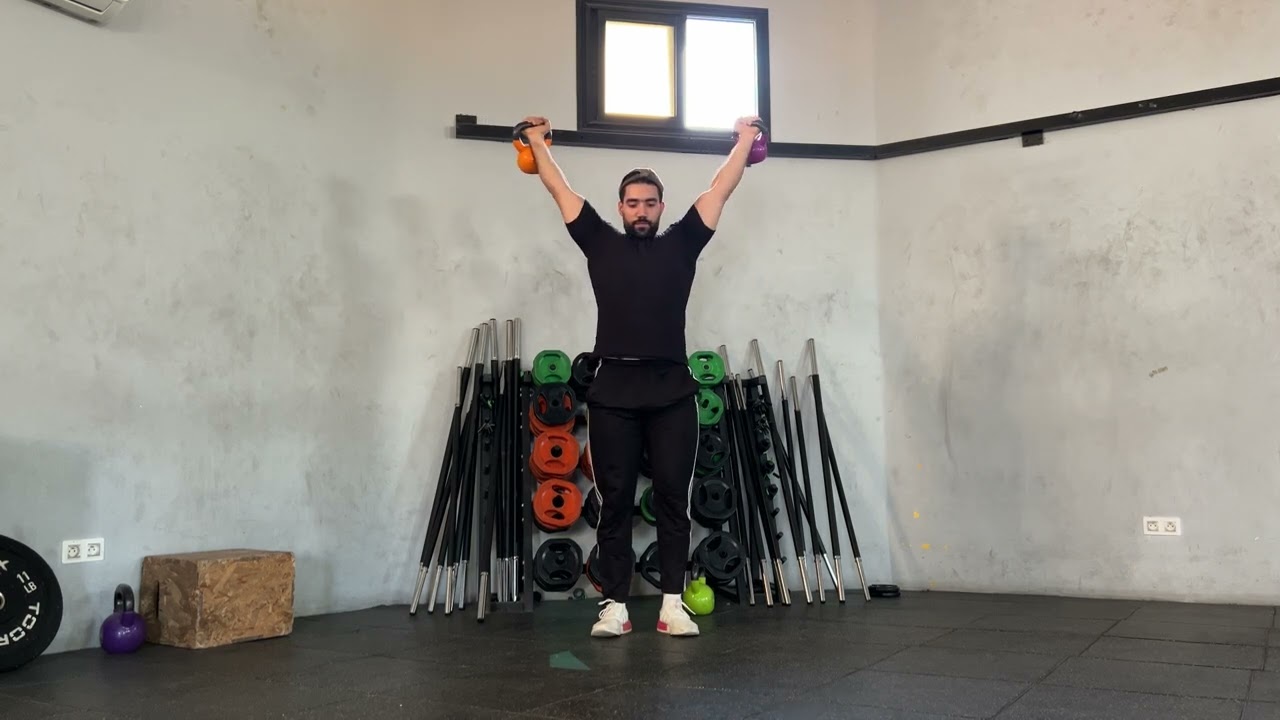
The Kettlebell Snatch-Grip Shoulder Press is an advanced overhead pressing variation that emphasizes the shoulders and triceps while challenging upper-body stability and core control. The exercise uses a relatively wide, two-handed grip on a kettlebell handle, with the elbows positioned outward during the pressing movement. Unlike a conventional kettlebell shoulder press performed with one kettlebell in each hand or a single kettlebell in the rack position, this variation uses one kettlebell held with both hands.
The term snatch-grip traditionally describes a wide hand position used during barbell Olympic lifting. Because a kettlebell handle is considerably narrower than a barbell, the Kettlebell Snatch-Grip Shoulder Press cannot reproduce the same hand spacing. Instead, the exercise uses a wide-elbow pressing position relative to the available handle width. The movement should be performed only when the kettlebell allows a secure and comfortable two-handed grip.
To perform the exercise, begin by selecting a lightweight kettlebell with a handle wide enough for both hands. Stand with your feet approximately shoulder-width apart and maintain a neutral spine. Lift the kettlebell into a controlled position in front of your upper chest, gripping the outer portions of the handle. Keep your elbows angled outward without forcing them into an uncomfortable position.
Brace your abdominal muscles and maintain your rib cage above your pelvis. Keep your shoulders stable and your feet firmly planted on the floor. Initiate the press by extending your elbows and driving the kettlebell upward. Allow your shoulder blades to rotate naturally as your arms move overhead.
Continue pressing until your elbows approach full extension and the kettlebell reaches a stable overhead position. Maintain control of the weight and avoid allowing it to tilt excessively. Keep your wrists as neutral as the grip allows and avoid leaning backward to compensate for limited shoulder mobility.
At the top of the movement, pause briefly while maintaining stable shoulders and abdominal tension. Your arms should be extended overhead without excessive lower-back arching. Begin the lowering phase by bending your elbows and bringing the kettlebell back toward your upper chest under control. Repeat the movement for the desired number of repetitions.
The deltoid muscles are the primary muscles involved in the Kettlebell Snatch-Grip Shoulder Press. The anterior deltoids contribute substantially to shoulder flexion during the upward phase, while the middle deltoids assist with raising and stabilizing the upper arms. The exact muscular emphasis depends on elbow positioning, shoulder mobility, and the path of the kettlebell.
The triceps brachii assist with elbow extension as the kettlebell moves overhead. The upper trapezius, lower trapezius, and serratus anterior contribute to scapular upward rotation and overhead stability. These muscles work together to support efficient shoulder movement throughout the pressing range.
The abdominal muscles and spinal stabilizers also play important roles. As the kettlebell moves overhead, the trunk must resist excessive spinal extension and maintain stable alignment. Keeping the rib cage stacked above the pelvis helps prevent the athlete from compensating for limited shoulder mobility by arching the lower back.
One potential benefit of this exercise is the opportunity to train overhead pressing with a different arm position. The outward elbow orientation changes the relationship between the upper arms, shoulders, and kettlebell compared with a conventional neutral-grip press. However, a wider elbow position is not automatically more effective for shoulder development and may be less comfortable for some individuals.
Another benefit is the stabilization challenge created by holding a single kettlebell with both hands. Because the load is concentrated beneath the handle, the athlete must control its orientation throughout the movement. This requires coordinated grip strength, shoulder stability, and trunk control.
The exercise differs from the standard Single-Arm Kettlebell Shoulder Press, which uses one hand and generally begins from a rack position. It also differs from the Double Kettlebell Shoulder Press, which uses two separate kettlebells and allows each arm to move independently. The snatch-grip variation places both hands on one implement and uses a distinct elbow orientation.
A common mistake is attempting to create an excessively wide grip on a kettlebell handle that cannot safely accommodate both hands. Unlike a barbell, a kettlebell offers limited hand placement options. If the handle is too narrow, the athlete may lose grip security or place unnecessary stress on the wrists. Selecting an appropriate kettlebell is essential.
Another common mistake is forcing the elbows directly outward during the press. Extreme elbow flaring may create discomfort for individuals with limited shoulder mobility or sensitivity in certain positions. Instead, maintain an outward elbow angle that allows smooth, pain-free shoulder movement.
Excessive lower-back arching is another technique error. This often occurs when the athlete attempts to press overhead without sufficient shoulder mobility or trunk control. Keep your abdominal muscles engaged and avoid leaning backward to move the kettlebell into position. Reduce the range of motion or select another pressing variation if proper alignment cannot be maintained.
The Kettlebell Snatch-Grip Shoulder Press is best approached as an accessory shoulder exercise rather than a primary heavy overhead lift. The unusual grip configuration may limit the resistance that can be used safely. Moderate loads and controlled repetitions are generally more appropriate than maximal lifting attempts.
For beginners, a conventional kettlebell shoulder press or two-handed kettlebell overhead press with a comfortable grip is usually a more practical starting point. These exercises help develop shoulder strength, overhead mobility, and pressing coordination before introducing less conventional grip positions.
More experienced individuals may incorporate the snatch-grip variation into shoulder-focused workouts when the handle design and individual mobility allow comfortable execution. The movement can be used to provide variety within an overhead pressing program, although it should not replace more established pressing exercises without a specific training reason.
Overall, the Kettlebell Snatch-Grip Shoulder Press is a specialized shoulder-strengthening exercise that combines a two-handed kettlebell grip with an outward elbow pressing position. When performed with an appropriate kettlebell, secure grip, comfortable shoulder mechanics, and controlled overhead movement, it can provide an alternative pressing stimulus while challenging upper-body and core stability.


