
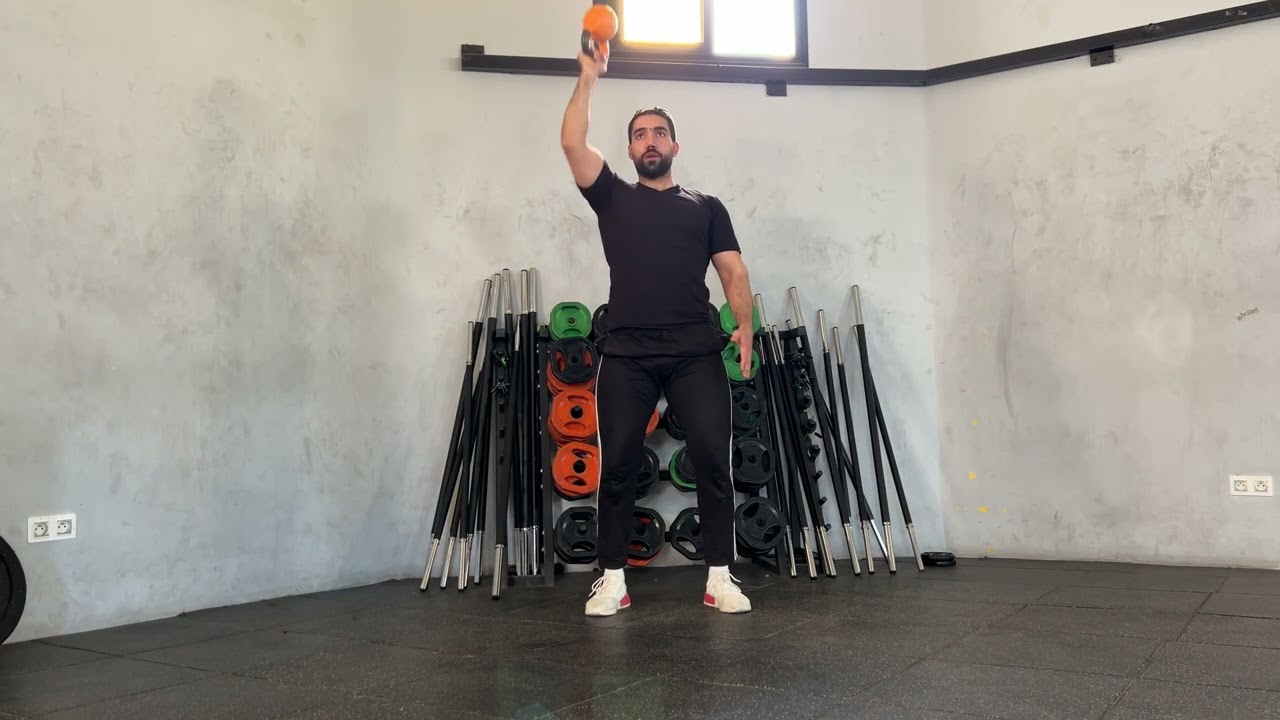
The Single-Arm Bottoms-Up Kettlebell Press is an advanced overhead strength exercise that primarily targets the shoulders while challenging grip strength, wrist stability, and core control. Unlike a traditional kettlebell shoulder press, this variation requires the kettlebell to remain inverted, with the weighted bell positioned above the handle. The unstable loading position increases the coordination required to maintain control throughout the pressing movement.
The exercise primarily engages the deltoids, while the triceps assist with elbow extension. The forearms work continuously to stabilize the kettlebell, and the traps and upper-back muscles contribute to shoulder blade control. The core and obliques help maintain an upright torso and resist unwanted leaning or rotation as the weight moves overhead.
To perform the Single-Arm Bottoms-Up Kettlebell Press, begin standing with your feet approximately shoulder-width apart. Hold a lightweight kettlebell by its handle and carefully position it upside down near your shoulder. The weighted bell should point toward the ceiling while your hand remains beneath it. Keep your wrist straight and your forearm approximately vertical.
Before pressing, establish a secure grip and brace your abdominal muscles. Maintain a tall posture with your ribs aligned over your pelvis. Your opposite arm can remain relaxed at your side or move slightly outward to assist with balance. The kettlebell should remain stable in the rack position before you begin the overhead movement.
Initiate the press by extending your elbow and raising your upper arm. Move the kettlebell upward in a smooth, controlled path while maintaining the bottoms-up position. Keep your wrist aligned with your forearm and avoid allowing the kettlebell to tip forward, backward, or sideways.
As your arm moves overhead, allow your shoulder blade to rotate naturally. Continue pressing until your elbow reaches a comfortable extended position and the kettlebell is balanced above your shoulder. Avoid leaning backward or excessively arching your lower back to achieve the overhead position.
At the top of the movement, briefly maintain control of the inverted kettlebell. Your arm should remain stable, your wrist should stay straight, and your torso should remain upright. Slowly bend your elbow to lower the kettlebell back toward your shoulder, maintaining the same controlled position throughout the descent.
The shoulders are the primary muscles responsible for the overhead pressing action. The anterior and lateral portions of the deltoids contribute to raising the arm, while surrounding shoulder muscles assist with stabilization. Because the kettlebell is inverted, the shoulder must coordinate the pressing movement while responding to small changes in the position of the load.
The triceps contribute by extending the elbow during the upward phase. They also help control elbow flexion as the kettlebell returns toward the shoulder. The traps and upper-back muscles assist with positioning and rotating the shoulder blade, supporting controlled overhead movement.
The forearms play an especially important role in the Single-Arm Bottoms-Up Kettlebell Press. Maintaining the inverted position requires continuous grip pressure and wrist stabilization. If the handle shifts or the wrist bends excessively, the kettlebell can become difficult to balance. A secure grip helps keep the weighted bell aligned above the hand.
The core and obliques help stabilize the torso against the uneven loading created by holding a kettlebell on one side. These muscles resist excessive sideways leaning, rotation, and lower-back extension. Maintaining abdominal tension allows the shoulder and arm to perform the pressing movement without unnecessary assistance from the torso.
One common mistake is selecting a kettlebell that is too heavy. The bottoms-up position requires greater balance and control than a conventional kettlebell press. Even a relatively light kettlebell can feel challenging because the weighted portion must remain balanced above the handle. Choose resistance that allows a stable rack position and controlled overhead movement.
Another common mistake is allowing the wrist to bend backward. Excessive wrist extension reduces the ability to maintain a stable relationship between the hand, forearm, and kettlebell. Keep your wrist relatively straight and squeeze the handle firmly throughout the exercise.
Leaning backward during the press is another frequent error. This compensation often occurs when the weight is too heavy or overhead mobility is limited. Maintain a stable torso, keep your ribs controlled, and press only through a comfortable range of motion.
The Single-Arm Bottoms-Up Kettlebell Press differs from the traditional Single-Arm Kettlebell Press because the bell remains inverted rather than resting against the back of the forearm. This changes the balance requirements and places greater emphasis on grip control, wrist positioning, and coordinated shoulder stability.
Overall, the Single-Arm Bottoms-Up Kettlebell Press is an effective exercise for developing shoulder strength, grip endurance, wrist stability, and upper-body coordination. When performed with an appropriate kettlebell, secure grip, controlled pressing path, stable torso, and deliberate lowering phase, it provides a challenging variation of the traditional overhead kettlebell press.


