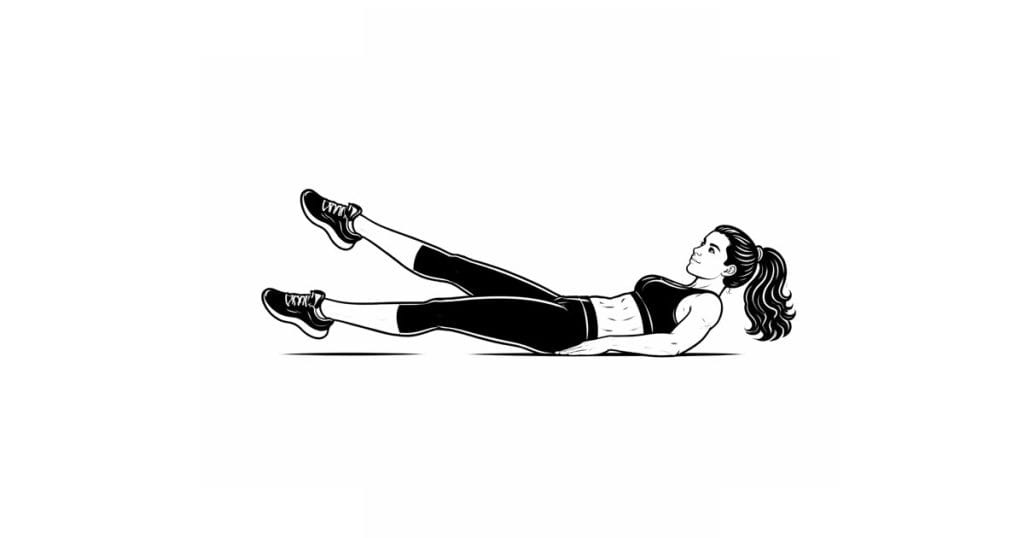
The Stability Ball Deadbug is a core stabilization exercise that strengthens the abdominal muscles, improves trunk stability, and enhances movement coordination while reinforcing proper spinal alignment. By placing a stability ball between the hands and knees, this variation increases the challenge of the traditional dead bug by requiring constant pressure on the ball while the opposite arm and leg move independently. Rather than creating movement through the spine, the exercise teaches the core to resist unwanted motion, making it highly effective for developing functional strength that transfers to sports, lifting, and everyday activities.
The primary muscle group targeted during the Stability Ball Deadbug is the abs and core. The rectus abdominis helps prevent excessive spinal extension, while the transverse abdominis and other deep core stabilizers create intra-abdominal pressure to maintain a neutral spine throughout the exercise. Because the abdominal muscles work isometrically instead of producing movement, this exercise develops anti-extension strength and improves overall core stability.
Several secondary muscle groups contribute during the movement. The hip flexors help control the moving leg, while the shoulders and upper-body stabilizers remain active as they press into the stability ball. The glutes also assist by helping stabilize the pelvis, and the muscles surrounding the spine work together to maintain proper alignment throughout every repetition. This coordinated muscle activation makes the exercise beneficial for both strength and movement efficiency.
One of the greatest benefits of the Stability Ball Deadbug is improved anti-extension core strength. Instead of repeatedly flexing the spine like a traditional crunch, the exercise trains the abdominal muscles to resist lower-back arching while the arms and legs move independently. This type of stability is essential during heavy lifting, athletic performance, and daily activities that require a strong, stable trunk.
Another major benefit is enhanced coordination and neuromuscular control. Pressing into the stability ball while moving opposite limbs teaches the body to coordinate upper- and lower-body movement while maintaining spinal stability. This improves movement quality and reinforces proper motor control patterns that carry over to more advanced exercises.
The exercise also improves balance, posture, and proprioception. The constant pressure applied to the stability ball increases activation throughout the core while enhancing body awareness. Over time, this can improve posture, spinal control, and overall functional movement.
To perform the Stability Ball Deadbug, lie on your back with your hips and knees bent to approximately 90 degrees and your arms extended toward the ceiling. Place a stability ball between your hands and knees and press firmly into the ball to create full-body tension. Brace your core and gently flatten your lower back against the floor without excessively tilting your pelvis.
Slowly extend one arm overhead while simultaneously extending the opposite leg toward the floor. Throughout the movement, continue pressing firmly into the stability ball with the stationary arm and leg. Move only as far as you can while maintaining contact between your lower back and the floor. Return to the starting position before repeating on the opposite side.
Proper technique is essential for maximizing results. Perform each repetition slowly and deliberately while maintaining constant pressure on the ball. Focus on keeping your ribs down, your core engaged, and your breathing controlled. Exhale as your arm and leg extend to help maintain abdominal tension, then inhale as you return to the starting position.
Common mistakes include allowing the lower back to arch away from the floor, relaxing pressure against the ball, moving too quickly, extending the limbs farther than your core can control, or holding your breath. These errors reduce core activation and compromise spinal stability. Maintaining slow, controlled movement and consistent tension produces the greatest training benefit.
From a safety standpoint, the Stability Ball Deadbug is appropriate for beginners and experienced exercisers because it uses bodyweight resistance while emphasizing proper movement quality. Begin with a smaller range of motion if maintaining spinal alignment is difficult, and gradually increase the movement as your core strength improves.
Overall, the Stability Ball Deadbug is an excellent exercise for strengthening the core, improving spinal stability, enhancing coordination, and developing functional anti-extension strength. Its combination of full-body tension, controlled movement, and stability-ball training makes it a valuable addition to rehabilitation programs, athletic conditioning, and general core workouts.