The Stability Ball Crunch is a bodyweight abdominal exercise that strengthens the core while providing a greater range of motion than a traditional floor crunch. By performing the movement on a stability ball, the torso can extend further at the bottom of each repetition, placing the abdominal muscles under a greater stretch before contracting. The unstable surface also requires continuous core stabilization, making this exercise highly effective for improving abdominal strength, muscular endurance, balance, and trunk control.
The primary muscle group targeted during the Stability Ball Crunch is the abs and core, specifically the rectus abdominis. This muscle is responsible for flexing the spine as you curl your ribcage toward your pelvis during each repetition. The increased range of motion provided by the stability ball allows the rectus abdominis to work through a larger movement arc, increasing muscle activation compared to performing crunches on the floor.
Several secondary muscle groups assist during the exercise. The obliques stabilize the torso and help control spinal movement, while the transverse abdominis and other deep core stabilizers remain active to maintain balance on the unstable surface. When performed correctly, the hip flexors contribute very little, allowing the abdominal muscles to perform most of the work.
One of the greatest benefits of the Stability Ball Crunch is its increased range of motion. Unlike floor crunches, where the spine reaches the ground and limits extension, the curved surface of the stability ball allows the torso to move through a greater stretch before each contraction. This increased range places the abdominal muscles under more tension and can lead to greater strength development.
Another major benefit is improved core stability and balance. The unstable surface requires continuous activation of the deep stabilizing muscles throughout every repetition. These muscles help maintain posture, stabilize the spine, and improve overall trunk control, making the exercise beneficial for both athletic performance and everyday movement.
The Stability Ball Crunch also promotes functional core strength by improving the ability to control spinal movement while maintaining balance. A stronger core supports better posture, enhances force transfer between the upper and lower body, and contributes to improved performance during compound lifts and athletic activities.
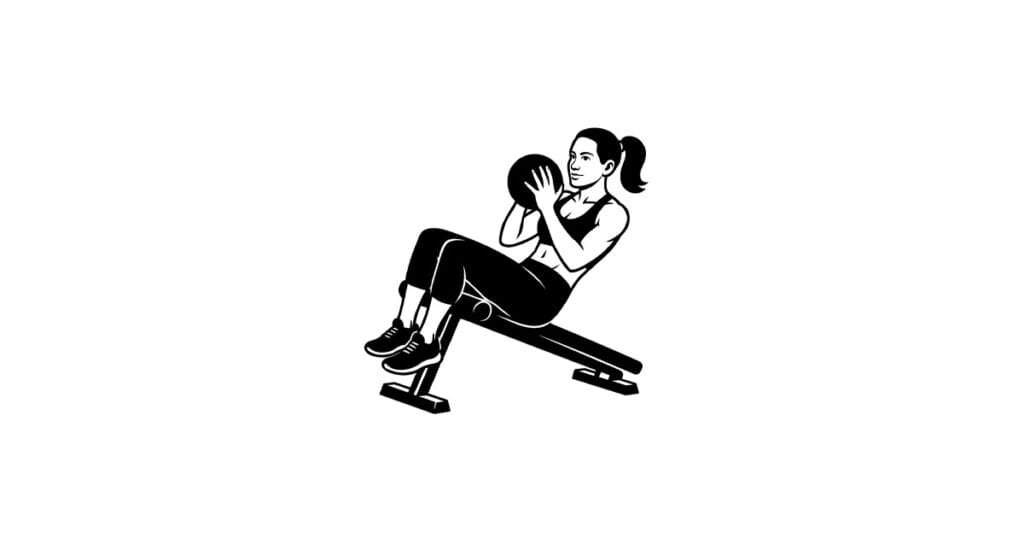
To perform the Stability Ball Crunch, sit on the center of a stability ball and slowly walk your feet forward until your lower back rests comfortably against the ball. Keep your feet flat on the floor approximately shoulder-width apart with your knees bent around 90 degrees. Place your hands lightly beside your head or cross your arms over your chest.
Begin with your torso comfortably extended over the ball to create a gentle stretch through the abdominals. Brace your core and curl your ribcage toward your pelvis until your shoulders lift off the ball. Pause briefly while squeezing your abdominal muscles before slowly lowering yourself back to the starting position under control, allowing your core to fully lengthen before beginning the next repetition.
Proper technique is essential for maximizing results. Focus on curling through your spine rather than performing a sit-up. Keep your neck relaxed, maintain steady breathing, and perform each repetition slowly without using momentum. Exhale during the upward phase to increase abdominal activation and inhale as you return to the stretched starting position.
Common mistakes include pulling on the head with the hands, turning the movement into a full sit-up, using momentum, failing to move through the full range of motion, allowing the neck to flex excessively, or lifting the feet off the floor. These errors reduce abdominal activation and increase unnecessary stress on the neck and lower back. Controlled movement and proper positioning produce the best results.
From a safety standpoint, the Stability Ball Crunch is appropriate for beginners and advanced exercisers alike. Start with slow, controlled repetitions using only bodyweight before progressing to more challenging variations such as holding a weight plate or dumbbell across the chest. Individuals with lower back discomfort should perform the exercise only within a comfortable range of motion and consult a qualified professional if needed.
Overall, the Stability Ball Crunch is an excellent exercise for strengthening the abdominal muscles, improving core stability, increasing trunk control, and enhancing posture. Its combination of increased range of motion and instability makes it an effective progression beyond traditional crunches while remaining accessible for individuals of all fitness levels.