
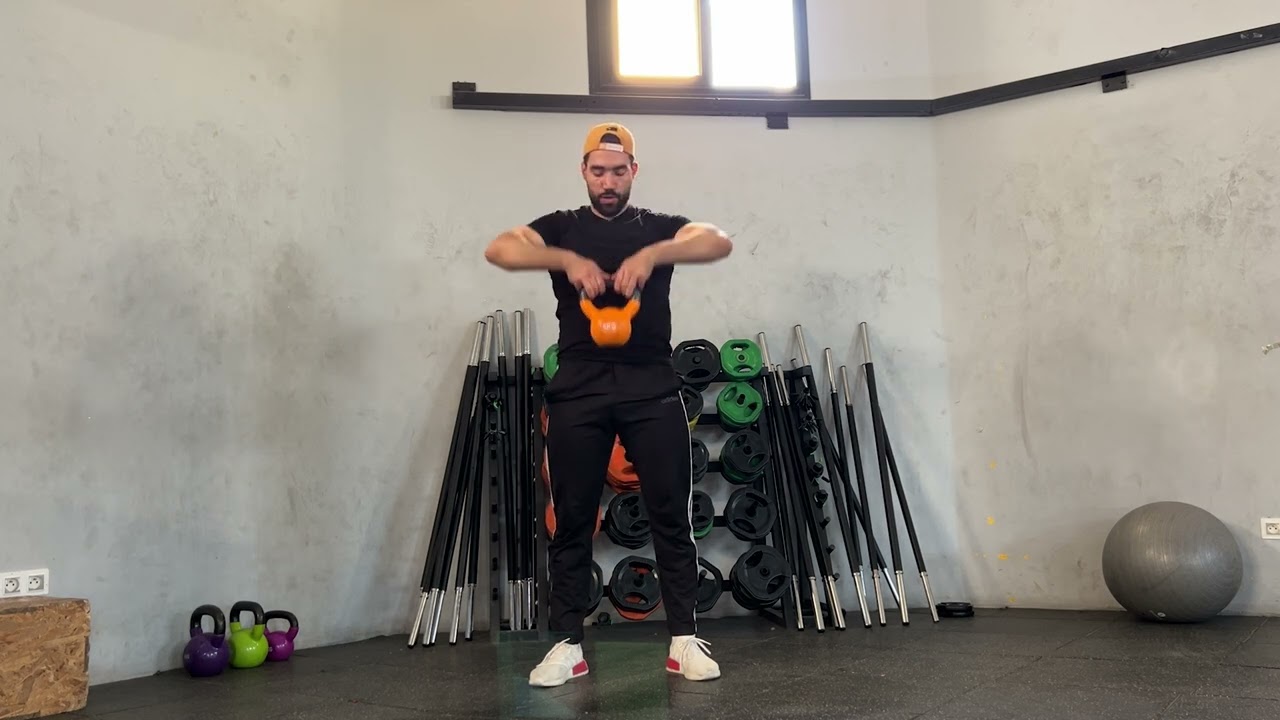
The Kettlebell Upright Row is an upper-body strength exercise that primarily targets the shoulder muscles while also engaging the trapezius, upper back, biceps, and forearms. The movement involves holding one kettlebell with both hands in front of the thighs and pulling it upward along the front of the torso by bending the elbows and raising the upper arms. Unlike explosive kettlebell high pulls, the upright row is performed using a controlled lifting and lowering tempo without significant assistance from the hips or legs.
The Kettlebell Upright Row is commonly included in shoulder-focused strength workouts and upper-body accessory training. Its primary purpose is to challenge the deltoids and upper trapezius through a controlled pulling movement. However, the exercise requires careful attention to shoulder positioning because excessive pulling height and certain combinations of shoulder elevation and internal rotation may cause discomfort for some individuals.
To perform the Kettlebell Upright Row, begin by selecting a manageable kettlebell and standing with your feet approximately hip-width to shoulder-width apart. Hold the kettlebell securely with both hands in front of your thighs. Keep your arms extended with a slight natural bend at the elbows and maintain a comfortable wrist position.
Stand upright with your rib cage aligned above your pelvis. Brace your abdominal muscles and maintain stable pressure through both feet. Keep your shoulders in a natural position and avoid excessive tension in your neck. Your torso should remain approximately upright throughout the exercise.
Initiate the movement by bending your elbows and raising your upper arms outward and upward. Guide the kettlebell along the front of your torso while keeping it relatively close to your body. The elbows should move outward naturally, but they should not be forced excessively high.
Continue raising the kettlebell until you reach a comfortable range of motion, typically around the upper abdomen or lower chest. The exact height will depend on your shoulder mobility, grip position, and individual anatomy. Avoid forcing the kettlebell toward your chin if doing so requires uncomfortable shoulder positioning.
At the top of the movement, maintain a stable torso and controlled shoulder position. Pause briefly without shrugging excessively or leaning backward. Begin the lowering phase by gradually extending your elbows and guiding the kettlebell back toward your thighs.
Lower the kettlebell under control until your arms return to the starting position. Avoid allowing the weight to drop abruptly or swing away from your body. Reestablish your abdominal tension and shoulder positioning before beginning the next repetition.
The deltoid muscles are major contributors to the Kettlebell Upright Row. The middle deltoid is particularly involved in raising the upper arm away from the torso, while the anterior deltoid can assist depending on the movement path and shoulder position. These muscles work to produce and control shoulder elevation during the lifting and lowering phases.
The upper trapezius also contributes to the movement by assisting with shoulder-blade upward rotation and elevation. The middle and lower portions of the trapezius, along with the serratus anterior and other scapular stabilizers, help coordinate shoulder-blade positioning as the arms rise. Allowing natural scapular movement is important for maintaining comfortable shoulder mechanics.
The biceps brachii, brachialis, and brachioradialis assist with elbow flexion as the kettlebell moves upward. Although the upright row is primarily considered a shoulder-focused exercise, the elbow flexors contribute to guiding the weight through the pulling phase. Their involvement depends partly on grip position, resistance, and the degree of elbow bending.
The forearm muscles work to maintain a secure grip on the kettlebell handle and stabilize the wrists throughout the movement. Because the kettlebell is held with both hands, grip comfort and handle dimensions can influence how naturally the wrists and shoulders move. A comfortable grip should allow the athlete to perform the exercise without excessive wrist bending.
The abdominal muscles and spinal stabilizers work isometrically to maintain an upright torso. The rectus abdominis, obliques, transverse abdominis, and erector spinae help resist excessive trunk movement as the kettlebell rises. Their role is primarily stabilization rather than producing the pulling motion.
One of the main benefits of the Kettlebell Upright Row is its ability to provide a shoulder-focused resistance exercise using minimal equipment. A single kettlebell can be used to challenge the deltoids and upper trapezius without requiring a cable machine or specialized strength equipment. This makes the exercise accessible for home workouts and general strength training programs.
Another benefit is the opportunity to practice controlled shoulder and elbow movement under resistance. When performed through a comfortable range of motion, the exercise challenges the muscles responsible for raising and stabilizing the arms. A slow, controlled lowering phase can also increase muscular time under tension and improve awareness of shoulder positioning.
The Kettlebell Upright Row may also contribute to upper-body muscular endurance when performed with moderate resistance and appropriate repetitions. Because the movement recruits several shoulder and arm muscles simultaneously, repeated controlled sets can create a localized muscular challenge. However, resistance and repetition volume should remain appropriate for the athlete's shoulder tolerance.
One important consideration is that the upright row is not equally comfortable for everyone. The movement combines upper-arm elevation with a degree of shoulder internal rotation, depending on the grip and pulling path. For some individuals, particularly those with existing shoulder irritation or limited mobility, this combination may produce discomfort. The exercise should therefore be performed only through a comfortable, controlled range.
A common mistake is pulling the kettlebell excessively high toward the chin. This often causes the elbows to rise above shoulder height and may increase discomfort in the shoulder joint. Raising the weight higher does not automatically make the exercise more effective. A lower pulling range that allows stable, pain-free shoulder mechanics is generally preferable.
Another common mistake is using excessive resistance. When the kettlebell is too heavy, the athlete may compensate by leaning backward, shrugging aggressively, or using momentum from the hips and knees. These compensations reduce the emphasis on controlled shoulder movement and may increase unnecessary stress on other joints. Begin with a manageable weight and progress gradually.
Allowing the kettlebell to move too far away from the body is another technique error. A forward-drifting kettlebell changes the resistance demands and may encourage excessive torso movement. Keep the weight relatively close to your body while allowing a natural movement path that accommodates your wrists and shoulders.
Excessive wrist bending can also cause discomfort. Because both hands share one kettlebell handle, the available grip width may be narrower than with a barbell or two dumbbells. Athletes should avoid forcing the wrists into an uncomfortable position and may need to select an alternative exercise if the handle dimensions restrict natural movement.
The Kettlebell Upright Row differs from the Kettlebell Sumo High Pull because it is performed without explosive lower-body assistance. The sumo high pull begins with a wide-stance hip and knee drive that generates momentum before the upper-body pull. The upright row begins from a standing position and relies primarily on controlled shoulder and elbow movement to raise the kettlebell.
It also differs from the Kettlebell Swing. The swing is a ballistic hip-hinge exercise that primarily emphasizes glute and hamstring power, while the upright row is an upper-body resistance exercise focused on the shoulders and upper trapezius. Although both exercises involve moving a kettlebell upward, their mechanics and primary muscular demands are substantially different.
Compared with the Dumbbell Upright Row, the kettlebell variation uses a single shared handle rather than independent weights. Dumbbells allow each hand to move separately, potentially providing greater freedom to adjust grip width and arm position. The kettlebell variation may be convenient for athletes who have access to only one kettlebell, but its fixed handle configuration may not suit every individual's shoulder or wrist mechanics.
For beginners, it may be useful to practice shoulder raises and rowing movements separately before attempting the upright row. Learning to maintain a stable torso, comfortable shoulder positioning, and controlled elbow movement can help establish the necessary coordination. A lightweight kettlebell should be used initially to determine whether the movement feels comfortable.
More experienced lifters can incorporate Kettlebell Upright Rows into shoulder accessory workouts, upper-body training sessions, or full-body strength circuits. The exercise is generally better suited to controlled moderate-repetition sets than explosive, heavy lifting. Repetition quality, shoulder comfort, and controlled lowering should take priority over maximizing resistance or pulling height.
Progressive overload can be achieved by gradually increasing resistance, adding repetitions, or improving control throughout the movement. However, progression should not require raising the elbows excessively high, forcing additional shoulder rotation, or using momentum. If discomfort develops, reducing the range of motion or selecting a different shoulder exercise may be more appropriate than continuing to increase resistance.
Overall, the Kettlebell Upright Row is a shoulder-focused strength exercise that challenges the deltoids, trapezius, elbow flexors, and supporting stabilizers. When performed with manageable resistance, controlled movement, a comfortable pulling height, and appropriate shoulder mechanics, it can serve as an accessory exercise within a comprehensive upper-body strength training program.


