
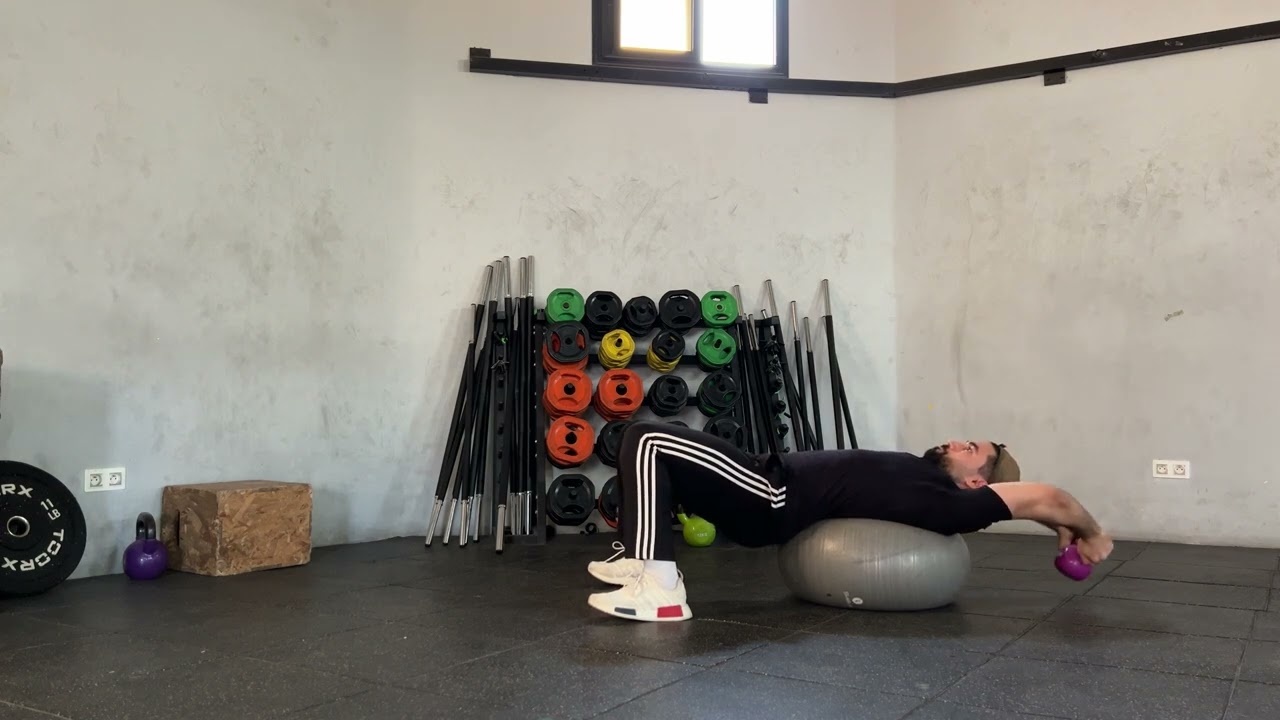
The Kettlebell Stability Ball Pullover is an advanced upper-body strength exercise that combines a traditional kettlebell pullover with the balance and trunk-stabilization demands of a stability ball. The movement primarily targets the latissimus dorsi while also engaging the chest, triceps, shoulders, upper back, glutes, and abdominal muscles. By supporting the upper back on a stability ball rather than a fixed bench, the exercise requires additional coordination to maintain a stable bridge position throughout the pullover.
The exercise is performed with one kettlebell held securely in both hands. The athlete positions the upper back on a stability ball, plants both feet on the floor, and lifts the hips into a bridge. From this position, the kettlebell is lowered backward behind the head through a controlled shoulder movement before being returned above the chest.
To begin, select a lightweight kettlebell and an appropriately sized stability ball. Sit on the ball with your feet planted on the floor. Carefully walk your feet forward until the ball supports your upper back and shoulder blades. Lift your hips until your torso forms an approximately straight line from your shoulders to your knees. Keep your glutes engaged and your abdominal muscles braced.
Hold the kettlebell securely with both hands above your chest. Maintain a slight bend in your elbows and keep your wrists in a comfortable position. Your shoulders should be stable, and your head and neck should remain aligned with your spine. Avoid excessively arching your lower back before beginning the movement.
Initiate the pullover by slowly lowering the kettlebell backward toward the area behind your head. Keep your elbows slightly bent and allow the movement to occur primarily through your shoulders. Maintain control of the kettlebell throughout the descent and prevent your rib cage from flaring upward.
Continue lowering until your upper arms approach alignment with your torso or you reach the limit of your comfortable shoulder mobility. The goal is not to force the kettlebell as far backward as possible. Instead, maintain a controlled range that allows your shoulders, trunk, and hips to remain stable.
At the bottom of the movement, pause briefly while maintaining tension through your upper body. Engage your latissimus dorsi and other shoulder extensors to bring the kettlebell forward through the same controlled arc. Continue until the weight returns above your chest. Keep your hips elevated and avoid using momentum to complete the repetition.
The latissimus dorsi is one of the primary muscles involved in the Kettlebell Stability Ball Pullover. These large back muscles contribute to shoulder extension as the arms move from an overhead position toward the torso. The teres major also assists with this action, while the chest and other shoulder muscles contribute to movement and stabilization depending on arm position.
The triceps, particularly the long head, can contribute to shoulder extension and help maintain elbow positioning. The rotator cuff muscles assist with shoulder stability, while the upper-back muscles coordinate scapular positioning throughout the movement. Maintaining a consistent elbow angle helps emphasize shoulder movement rather than turning the exercise into an elbow-extension exercise.
The stability ball introduces additional demands on the abdominal muscles, spinal stabilizers, and glutes. Because the upper back rests on a rounded, movable surface, the athlete must maintain balance while controlling the kettlebell. The glutes help support the bridge position, while the abdominal muscles resist excessive spinal extension as the weight travels behind the head.
One of the main benefits of the Kettlebell Stability Ball Pullover is its ability to combine upper-body resistance training with trunk stabilization. The pullover challenges the muscles responsible for controlling shoulder movement, while the bridge position requires the hips and torso to remain stable. This creates a coordinated exercise involving both the upper and lower body.
Another benefit is the opportunity to train shoulder movement through a controlled overhead range. The exercise requires the arms to move backward relative to the torso while the athlete maintains a stable trunk. However, the range of motion should always be determined by individual shoulder mobility and comfort rather than the desire to lower the kettlebell farther.
The exercise also encourages body awareness and coordination. Maintaining the bridge position while moving a kettlebell around the shoulder joints requires the athlete to control several body segments simultaneously. This makes the variation more technically demanding than a conventional pullover performed on a fixed bench.
A common mistake is allowing the hips to drop during the lowering phase. When the hips descend, the athlete may lose the intended bridge position and place additional demands on the lower back. Keep the glutes engaged and maintain a stable hip position throughout the movement.
Another common mistake is excessively arching the lower back as the kettlebell moves behind the head. This compensation often occurs when shoulder mobility is limited or the weight is too heavy. Maintain abdominal tension and keep the rib cage aligned with the pelvis. Reduce the lowering range if proper trunk alignment cannot be maintained.
Using excessive resistance is another technique error. The stability ball increases the coordination required to control the movement, making heavy kettlebells unnecessary for most individuals. A lighter weight allows the athlete to focus on shoulder mechanics, controlled repetitions, and maintaining a stable bridge.
The Kettlebell Stability Ball Pullover differs from the traditional Kettlebell Pullover on a bench because the support surface can move. A fixed bench provides greater stability and generally allows the athlete to concentrate more directly on upper-body loading. The stability ball variation introduces additional balance and trunk-control demands, although instability does not necessarily make it more effective for building maximal lat strength.
It also differs from the Dumbbell Stability Ball Pullover primarily in the equipment used. Both variations follow a similar movement pattern, but the kettlebell's handle and weight distribution can change how the resistance feels in the hands and shoulders. A secure grip and controlled kettlebell orientation are essential throughout the movement.
For beginners, a pullover performed on a stable bench is usually a more appropriate starting point. Once the athlete can control the weight through a comfortable shoulder range, the stability ball variation may be introduced with light resistance. Practicing the stability-ball bridge separately can also help develop the balance required for the combined exercise.
More experienced lifters can incorporate the Kettlebell Stability Ball Pullover into upper-body workouts, core-focused sessions, or functional strength circuits. It works particularly well as an accessory exercise when the goal is to combine shoulder control with trunk stability. Moderate repetitions and a slow tempo are generally more appropriate than heavy loading or explosive movement.
Overall, the Kettlebell Stability Ball Pullover is a challenging exercise that develops lat strength, shoulder control, core stability, and bridge endurance. When performed with a secure grip, appropriate resistance, stable hip positioning, and controlled shoulder movement, it provides a useful variation of the traditional pullover for individuals seeking an additional coordination and stabilization challenge.


