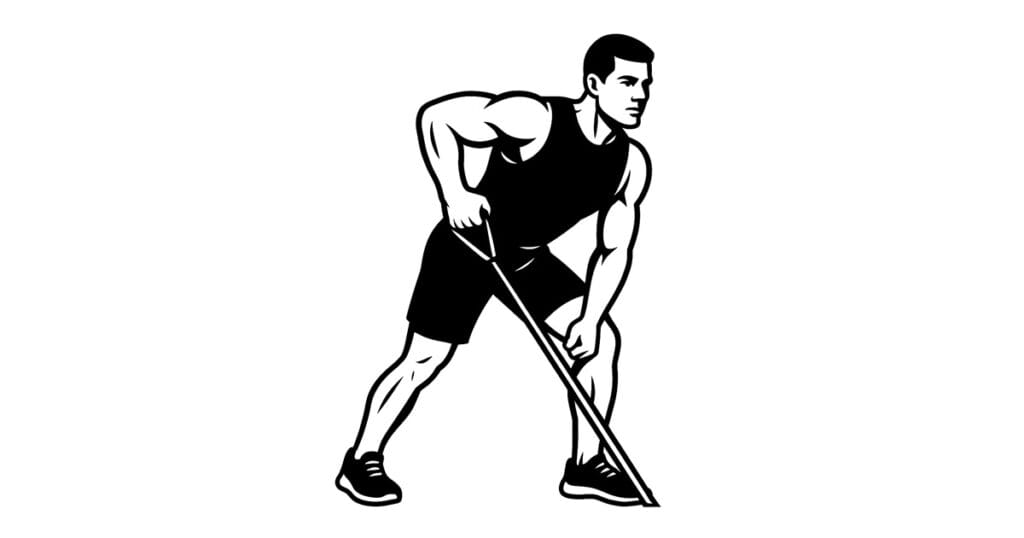
The Kettlebell Gorilla Row is an alternating pulling exercise performed from a wide, hinged stance with two kettlebells positioned on the floor between the feet. The exercise primarily targets the lats while also training the upper back, biceps, forearms, traps, shoulders, core, lower back, glutes, and hamstrings. Because one kettlebell remains supported on the floor while the opposite kettlebell is rowed, the movement combines upper-body pulling strength with substantial demands on torso stability and hip-hinge control.
To perform the Kettlebell Gorilla Row, place two kettlebells on the floor next to each other. Stand over them with your feet wider than hip-width apart and your toes positioned comfortably. Push your hips backward and bend your knees slightly until you can reach both kettlebell handles. Grip one kettlebell with each hand while keeping your spine controlled and your torso inclined toward the floor.
The starting position should resemble a stable hip hinge rather than a deep squat. Keep your hips pushed backward, your feet firmly planted, and your abdominal muscles braced. Both kettlebells should begin on the floor, allowing each side to start from a consistent position.
Begin by keeping one kettlebell planted firmly on the floor while rowing the opposite kettlebell upward. Drive your elbow backward toward your hip and pull the kettlebell toward the side of your torso. Keep the weight close to your body rather than allowing the elbow and kettlebell to flare excessively outward.
As the kettlebell rises, resist the tendency to rotate your torso. Your shoulders and hips should remain relatively level and directed toward the floor. Some natural movement may occur as the load shifts from side to side, but the core should prevent excessive twisting or rocking.
Once the kettlebell reaches the top of the row, briefly contract the muscles of the back before lowering the weight. Return the kettlebell to the floor under control rather than dropping it. Once it is stable, row the opposite kettlebell using the same technique. Continue alternating sides while maintaining your hinged position.
The lats are the primary muscles responsible for pulling the upper arm backward during each row. The upper back, traps, and rear portions of the shoulders assist with controlling the shoulder blade and maintaining strong upper-body positioning. The biceps contribute to elbow flexion, while the forearms work continuously to maintain a secure grip on the kettlebell handles.
The Kettlebell Gorilla Row also creates a significant demand on the core. Because only one kettlebell is moving at a time, the load attempts to rotate and shift the torso. The abdominal muscles must resist this movement and help keep the shoulders and hips relatively square. This anti-rotational demand distinguishes the Gorilla Row from many bilateral rowing exercises in which both arms move simultaneously.
The lower back, glutes, and hamstrings work isometrically to maintain the hip-hinge position. These muscles are not responsible for rowing the kettlebell, but they provide the stable platform needed for the upper body to produce force. Maintaining this position is an important part of proper Kettlebell Gorilla Row technique.
A common mistake is rotating the torso excessively to lift the kettlebell. Twisting can make it possible to move more weight, but it reduces the demand on the intended pulling muscles and changes the exercise. Brace your core and think about moving the arm while keeping the torso as stable as practical.
Another common error is repeatedly standing and lowering the torso between rows. The hips should remain pushed backward and the torso should maintain a relatively consistent angle throughout the set. If you cannot hold the hinge without your back rounding or your hips rising, the kettlebells may be too heavy or your setup may need adjustment.
Avoid jerking the kettlebell from the floor. Initiate each row with muscular tension and drive the elbow backward smoothly. Likewise, control the lowering phase until the kettlebell returns to a stable position on the floor. The alternating pattern should remain deliberate rather than becoming a rapid side-to-side rocking motion.
The planted kettlebell can also contribute to stability. Maintain a firm grip on its handle while the opposite arm rows. This creates a stable connection to the floor and can help you resist unwanted torso rotation. Avoid pushing so aggressively into the planted kettlebell that your shoulders become uneven or your body shifts excessively toward one side.
The Kettlebell Gorilla Row differs from a standard Kettlebell Bent-Over Row in both stance and execution. A traditional bent-over row may involve rowing two kettlebells simultaneously while maintaining a narrower hinge position. The Gorilla Row typically uses a wider stance, kettlebells positioned between the feet, and an alternating rowing pattern from the floor. These differences increase the rotational stability demands and create a distinctive alternating pulling movement.
Overall, the Kettlebell Gorilla Row is an effective compound pulling exercise for developing the lats, upper back, arms, grip, and core while reinforcing hip-hinge stability. When performed with a strong hinged position, controlled spinal alignment, minimal torso rotation, deliberate elbow drive, and controlled alternating repetitions, it provides an effective way to combine back strength with full-body stabilization.