The BOSU Squat (Platform Side) is an advanced lower-body exercise that combines the traditional squat with the instability of a BOSU trainer. Performed while standing on the flat platform with the dome facing downward, this variation places significantly greater demands on balance, coordination, and lower-body stability than the dome-side version. Because the platform rests on the unstable dome, your body must make continuous adjustments throughout every repetition, making this exercise highly effective for improving strength, proprioception, and neuromuscular control.
The primary muscle group targeted during the BOSU Squat (Platform Side) is the quads. The quadriceps are responsible for extending the knees as you rise from the squat, providing the primary force needed to return to the standing position. Because balance is constantly challenged, the quadriceps remain highly active throughout both the lowering and lifting phases of the movement.
Several secondary muscle groups contribute to the exercise. The glutes generate hip extension and help stabilize the pelvis, while the hamstrings assist with hip control and decelerate the lowering phase. The calves work continuously to stabilize the ankles on the unstable platform, and the abs and core, including the rectus abdominis, transverse abdominis, and obliques, brace the torso to maintain balance and proper posture. Numerous small stabilizing muscles in the feet and lower legs are also recruited more heavily than during traditional squats.
One of the greatest benefits of the BOSU Squat (Platform Side) is improved balance and proprioception. The unstable platform requires constant neuromuscular adjustments throughout each repetition, improving body awareness and joint control. These adaptations can enhance athletic performance, functional movement, and everyday balance.
Another major benefit is increased lower-body stability. The instability challenges the muscles surrounding the ankles, knees, and hips to work together to maintain alignment. This helps strengthen stabilizing muscles that are often undertrained during traditional squats and may improve movement efficiency during sports and daily activities.
The exercise also develops functional lower-body strength. While the squat strengthens the quadriceps and glutes, the unstable surface increases core activation and teaches the body to generate force while maintaining stability. Because balance becomes a limiting factor, bodyweight alone often provides a significant training challenge.
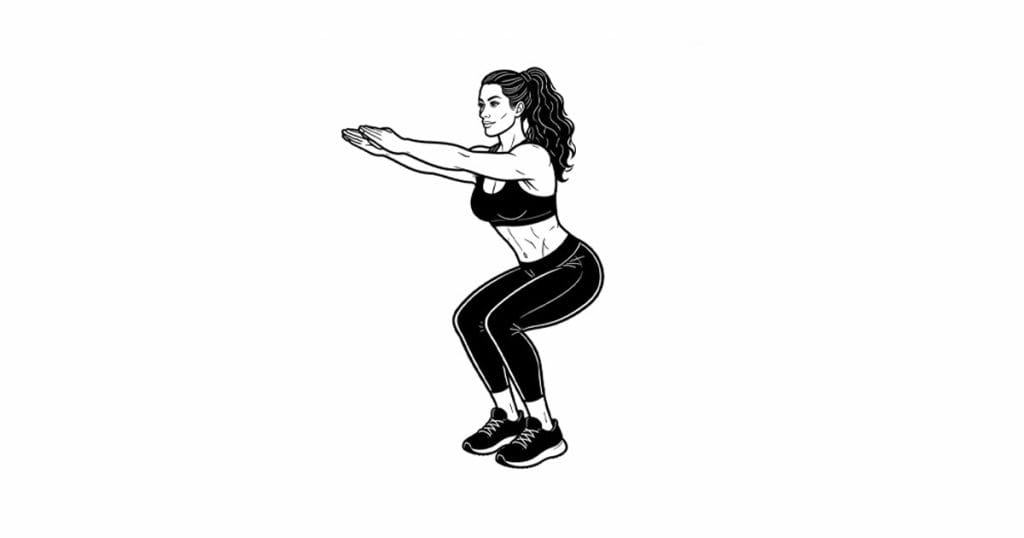
To perform the BOSU Squat (Platform Side), place the BOSU on a stable surface with the dome facing downward and the flat platform facing upward. Carefully step onto the center of the platform with your feet approximately shoulder-width apart. Establish your balance before beginning the movement.
Initiate the squat by pushing your hips backward while bending your knees under control. Lower to a comfortable depth without sacrificing posture or stability. Keep your chest lifted, your core engaged, and your knees tracking in line with your toes. Drive evenly through both feet to return to the starting position while maintaining balance throughout the movement.
Proper technique is essential for maximizing results. Perform slow, controlled repetitions, keep your weight centered over the platform, and prioritize stability over squat depth. Maintaining a neutral spine and full-body tension helps improve muscle activation while reducing unnecessary movement.
Common mistakes include allowing the knees to collapse inward, leaning excessively forward, standing too close to the edge of the platform, rushing through repetitions, or sacrificing balance to squat deeper. These errors reduce the effectiveness of the exercise and increase the risk of losing stability. Controlled movement and proper alignment should always take priority.
From a safety standpoint, the BOSU Squat (Platform Side) is best suited for intermediate and advanced individuals who have already mastered standard squats and dome-side BOSU squats. Beginners should first become comfortable balancing on the platform before performing full squats. If balance is compromised, reduce the squat depth or return to a more stable variation.
Overall, the BOSU Squat (Platform Side) is an excellent exercise for strengthening the quadriceps, glutes, calves, and core while improving balance, ankle stability, coordination, and lower-body control. Its highly unstable surface provides an effective progression for building functional strength and enhancing total-body movement quality.