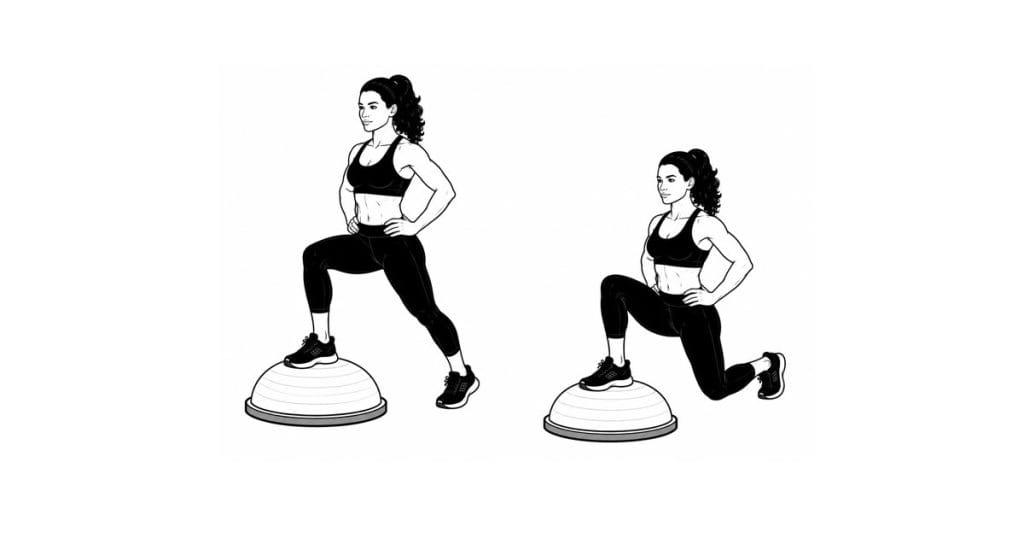
The BOSU Lateral Lunge (Foot on BOSU) is a functional lower-body exercise that combines the strength benefits of a lateral lunge with the balance challenge of an unstable surface. By placing the working foot on the dome of a BOSU trainer, this variation requires the muscles of the ankle, knee, hip, and core to continuously stabilize throughout the movement. Compared to a traditional side lunge, the BOSU variation increases the demand on balance, coordination, and proprioception while strengthening the major muscles of the lower body.
The primary muscle group targeted during the BOSU Lateral Lunge is the quadriceps. These muscles control the descent into the lunge and generate the force needed to extend the knee as you return to the starting position. Because the working foot is positioned on the unstable BOSU dome, the quadriceps must also contribute to maintaining balance, increasing overall muscle activation and control.
Several secondary muscle groups play an important supporting role. The gluteus maximus and gluteus medius stabilize the hips and pelvis while assisting with hip extension during the upward phase of the movement. The adductors lengthen as you lower into the lunge and help pull the body back to the starting position. The hamstrings assist with hip control and deceleration, while the abs and core work continuously to stabilize the torso and maintain proper posture. Small stabilizing muscles surrounding the ankles and hips remain active throughout every repetition to control the unstable BOSU surface.
One of the biggest benefits of the BOSU Lateral Lunge is its ability to improve lateral strength and movement quality. Many lower-body exercises focus primarily on forward and backward movement, but this exercise develops strength in the frontal plane, which is essential for sports, daily activities, and injury prevention. Strengthening the body through side-to-side movement helps improve agility, coordination, and overall lower-body function.
Another key benefit is improved balance and proprioception. The unstable BOSU trainer forces the body to make constant adjustments to maintain stability. This enhances neuromuscular coordination and improves the body’s awareness of joint position, helping develop better movement control and reducing the risk of injury during dynamic activities.
The BOSU Lateral Lunge also promotes single-leg stability. Because the working leg supports the majority of the body’s weight on an unstable surface, the exercise strengthens the muscles responsible for stabilizing the ankle, knee, and hip. Improved unilateral strength can help correct muscular imbalances while enhancing athletic performance and functional movement.
To perform the BOSU Lateral Lunge, place the BOSU dome-side up on a flat, stable surface. Stand with one foot centered on the dome and the opposite foot on the floor so your feet are wider than shoulder-width apart. Brace your core, lift your chest, and maintain an upright posture. Shift your hips backward while bending the knee of the leg standing on the BOSU, allowing the opposite leg to remain relatively straight. Lower into the lunge until you reach a comfortable depth while maintaining control of the BOSU. Press firmly through the heel of the BOSU foot to return to the starting position. Complete all repetitions on one side before switching legs.
Proper technique is essential for maximizing the effectiveness of the exercise. Keep your knee aligned with your toes throughout the movement and avoid allowing it to collapse inward. Maintain an upright torso, keep your core engaged, and move slowly with control. Focus on pushing your hips backward rather than leaning forward, and distribute your weight evenly through the working foot.
Common mistakes include placing the foot too close to the edge of the BOSU, allowing the knee to cave inward, leaning excessively forward, or relying too much on the floor leg to push yourself back to the starting position. Moving too quickly often reduces stability and limits muscle activation. Controlled repetitions with proper alignment produce better results while minimizing injury risk.
From a safety perspective, begin with bodyweight until you become comfortable balancing on the BOSU. Perform the exercise on a stable, non-slip surface, and avoid forcing a range of motion that compromises your balance or alignment. As strength and stability improve, you can increase the depth of the lunge or add external resistance while maintaining excellent technique.
Overall, the BOSU Lateral Lunge (Foot on BOSU) is an excellent exercise for strengthening the legs, improving balance, enhancing hip stability, and developing better movement control. Its combination of unilateral strength training and instability makes it a valuable addition to lower-body workouts, athletic conditioning programs, functional fitness routines, and injury-prevention training.