The Stability Ball Hip Thrust is a bodyweight glute exercise that strengthens the hips while improving core stability, balance, and posterior chain control. Unlike a traditional hip thrust performed with the upper back supported on a bench, this variation uses a stability ball, creating an unstable surface that requires the hips, core, and shoulders to work together throughout the movement. The instability increases the demand on the stabilizing muscles while allowing the glutes to remain the primary force-producing muscle. This makes the exercise an excellent choice for improving hip extension strength, glute development, and functional movement.
The primary muscle group targeted during the Stability Ball Hip Thrust is the glutes. The gluteus maximus is responsible for extending the hips as you raise your pelvis from the floor. At the top of the movement, the glutes contract forcefully to produce full hip extension while maintaining proper pelvic alignment. Developing stronger glutes can improve athletic performance, posture, and lower-body power during activities such as running, jumping, squatting, and lifting.
Several secondary muscle groups assist throughout the exercise. The hamstrings contribute to hip extension and help stabilize the lower body, while the abs and core brace the trunk to maintain balance on the unstable stability ball. The lower back muscles work isometrically to support the spine, but they should stabilize rather than drive the movement. Together, these muscles create a strong and stable foundation that allows the glutes to perform most of the work.
One of the greatest benefits of the Stability Ball Hip Thrust is its increased range of motion. Because the upper back is elevated on the stability ball, the hips can travel through a greater range than during a traditional floor glute bridge. This places the glutes under tension for a longer portion of each repetition, helping improve muscle activation and strength development.
Another major benefit is enhanced core stability and balance. The unstable surface forces the core and hip stabilizers to remain active throughout the exercise to prevent unnecessary movement of the ball. This improves neuromuscular coordination, trunk control, and overall body awareness while strengthening the posterior chain.
The exercise also promotes better hip extension mechanics. Strong glutes are essential for efficient walking, running, jumping, and lifting. By emphasizing proper hip extension while minimizing excessive lumbar movement, the Stability Ball Hip Thrust helps reinforce healthy movement patterns that transfer to both sports and daily activities.
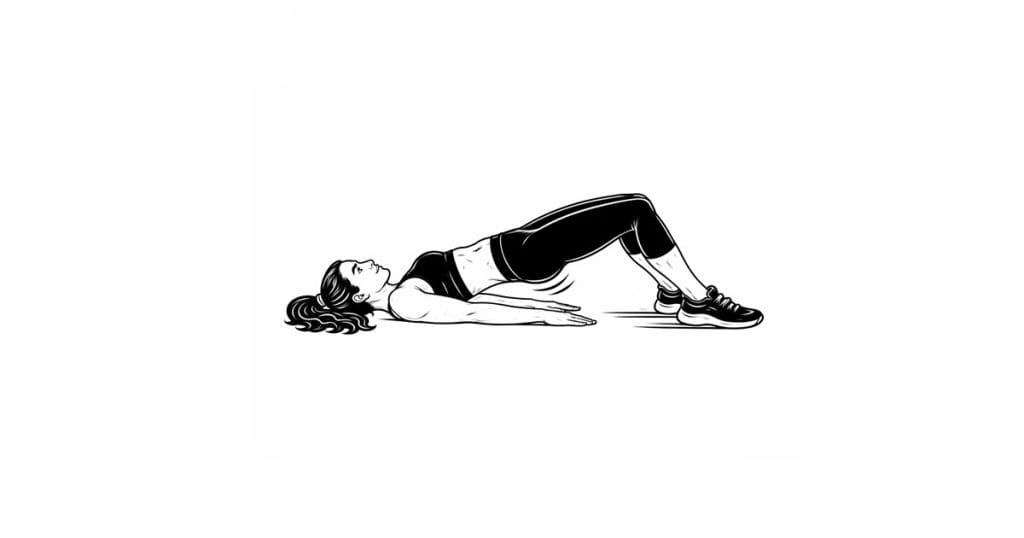
To perform the Stability Ball Hip Thrust, sit on the floor with your upper back resting against the front of a stability ball. Bend your knees and position your feet flat on the floor about hip-width apart. Brace your core, maintain a neutral head and neck position, and keep your feet planted firmly on the ground.
Drive through your heels to lift your hips toward the ceiling until your torso and thighs form a straight line. At the top of the movement, squeeze your glutes while keeping your ribs down and avoiding excessive arching of your lower back. Pause briefly before lowering your hips back to the starting position under control, allowing the stability ball to move naturally without losing your balance.
Proper technique is essential for maximizing results. Press through your heels rather than your toes, keep your knees aligned with your feet, and focus on driving the movement with your glutes instead of your lower back. Perform each repetition slowly and deliberately while maintaining steady breathing throughout the exercise.
Common mistakes include pushing through the toes, allowing the knees to collapse inward, hyperextending the lower back at the top of the movement, failing to reach full hip extension, or allowing the stability ball to roll excessively. These errors reduce glute activation and compromise stability. Maintaining full-body tension and controlling both the lifting and lowering phases will maximize effectiveness.
From a safety standpoint, the Stability Ball Hip Thrust is appropriate for individuals who have mastered a standard glute bridge. Beginners should first develop sufficient hip and core stability before progressing to the stability ball variation. If balance becomes difficult, reposition the ball or reduce the range of motion until proper control is maintained.
Overall, the Stability Ball Hip Thrust is an excellent exercise for strengthening the glutes, improving hip extension, enhancing posterior chain stability, and developing better balance and coordination. Its combination of increased range of motion and instability makes it an effective progression from traditional bodyweight hip bridges while reinforcing proper movement mechanics and core control.