
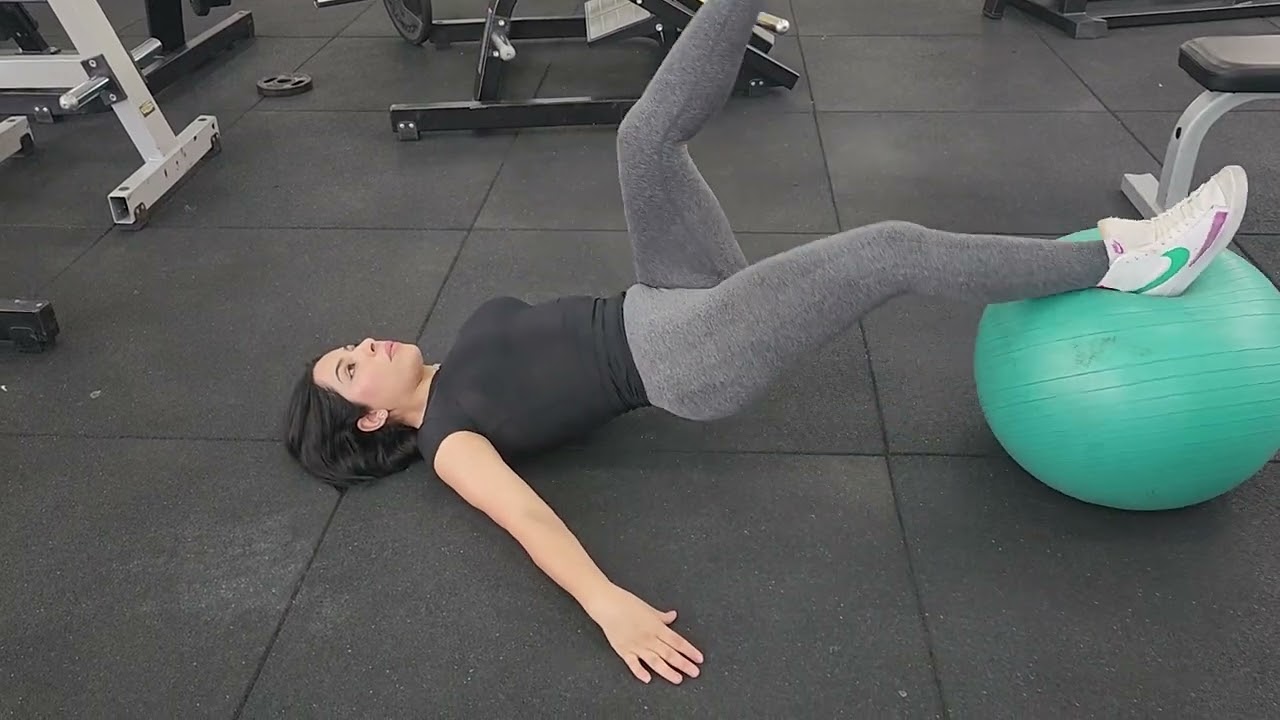
The Single-Leg Stability Ball Leg Curl is an advanced bodyweight hamstring exercise that combines unilateral knee flexion, hip extension, and core stabilization. Unlike the standard stability ball leg curl, which uses both legs to control the Swiss ball, this variation places nearly all of the workload on one leg at a time. The working hamstring must bend the knee and control the ball while the glutes and core stabilize the pelvis and keep the hips elevated. This makes the exercise highly effective for developing hamstring strength, correcting side-to-side strength differences, and improving posterior chain control.
The hamstrings are the primary muscles worked during the Single-Leg Stability Ball Leg Curl. They perform knee flexion as the heel pulls the Swiss ball toward the body and also assist with maintaining hip extension throughout the movement. The gluteus maximus helps keep the hips elevated, while the abdominal muscles stabilize the pelvis and prevent rotation. The calves contribute to maintaining contact with the ball and stabilizing the ankle during each repetition.
To perform the exercise, lie on your back with one heel resting on top of a Swiss ball. The opposite leg should remain off the ball and can be extended upward or held slightly away from the body. Place your arms at your sides for stability. Press your working heel into the ball and lift your hips until your body forms a straight line from your shoulders through your hips. From this bridge position, bend your working knee and pull the ball toward your glutes. Keep the hips elevated and level as the ball rolls toward you. Pause briefly at the top, then slowly extend the leg to roll the ball back to the starting position.
The unilateral nature of the exercise significantly increases the challenge compared to the two-leg version. With only one leg controlling the ball, the working hamstring must produce more force while the core and glutes resist rotation of the pelvis. This creates a strong combination of strength and stability demands without the need for external weights. The exercise also makes it easier to identify differences in strength or control between the left and right sides.
One of the main benefits of the Single-Leg Stability Ball Leg Curl is that it trains the hamstrings through both knee flexion and hip stabilization. The hamstrings cross both the hip and knee joints, so maintaining an elevated bridge while curling the ball challenges multiple functions of the muscle group at the same time. This makes the movement useful for developing functional posterior chain strength and improving control during running, jumping, hinging, and other lower-body activities.
The unstable Swiss ball further increases the coordination demands. Small shifts in the ball require continuous adjustments from the ankle, knee, hip, and core. These corrections improve proprioception and neuromuscular control while forcing the working leg to remain aligned throughout the movement. Maintaining a level pelvis is especially important because the body naturally wants to rotate when only one leg is supporting the lower body.
Common mistakes include allowing the hips to drop, rotating the pelvis, pushing through the toes instead of the heel, or using momentum to move the ball. Another frequent error is extending the leg too quickly during the return phase. The eccentric portion of the movement places significant demand on the hamstrings and should be performed slowly and under control. If the hips begin to drop or the pelvis rotates significantly, the range of motion should be reduced.
Proper breathing and abdominal bracing help maintain stability. Exhaling as the ball is pulled toward the body can reinforce core engagement, while inhaling during the controlled extension helps maintain steady movement. The focus should remain on keeping the hips elevated, the pelvis level, and the ball moving smoothly throughout each repetition.
Overall, the Single-Leg Stability Ball Leg Curl is an effective advanced exercise for strengthening the hamstrings, glutes, and core while improving unilateral stability and posterior chain control. Its combination of single-leg loading, hip extension, knee flexion, and an unstable support surface creates a demanding bodyweight exercise that develops strength, coordination, and muscular control.


