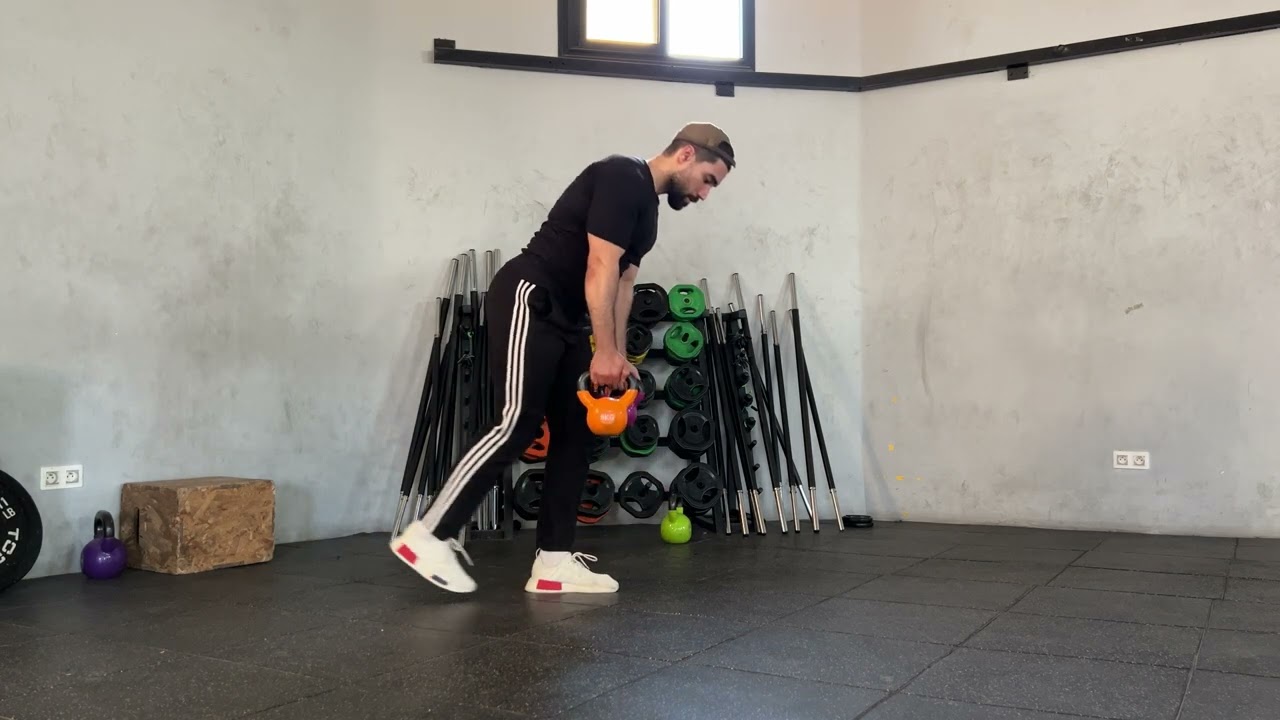
Double Kettlebell Single-Leg Deadlift to Row

  • MuscleHamstrings
  • EquipmentKettlebell
  • LevelAdvanced

Muscles worked

Double Kettlebell Single-Leg Deadlift to Row
ChestObliquesAbsBicepsTricepsNeckFront deltsAdductorsQuadsCalvesForearms
Front
TrapsRear deltsUpper backTricepsLower backForearmsGlutesHip abductorsHamstringsCalvesCalvesCalves
Back
PrimarySecondary
Exercise guide

How to do the Double Kettlebell Single-Leg Deadlift to Row

The Double Kettlebell Single-Leg Deadlift to Row is an advanced compound strength exercise that combines a unilateral hip hinge with a simultaneous two-arm kettlebell row. The movement primarily targets the hamstrings while also strengthening the glutes, latissimus dorsi, upper back, biceps, and core stabilizers. Performing the row while balancing in a single-leg deadlift position creates a demanding combination of posterior-chain strength, upper-body pulling, coordination, and balance.

Unlike a conventional double kettlebell deadlift, which uses both legs to support the resistance, this exercise places most of the lower-body loading demand on one leg. The addition of a bent-over row increases the time spent maintaining the hip hinge and challenges the trunk to remain stable while both kettlebells move. This makes it a useful option for experienced lifters seeking a combined lower-body and upper-body strength exercise.

To perform the movement, begin by standing upright with one kettlebell in each hand. Position your feet approximately hip-width apart, brace your abdominal muscles, and shift your weight onto one leg. Maintain a slight bend in the supporting knee while lifting the opposite foot slightly off the floor. Keep your shoulders level and your hips facing forward.

Initiate the deadlift by pushing your hips backward. As your torso leans forward, extend your non-working leg behind your body. Allow both kettlebells to travel downward beneath your shoulders while keeping your spine neutral. Continue hinging until your torso approaches a position roughly parallel to the floor or until you reach the limit of your available hip mobility.

Once you reach a stable bottom position, maintain the hinge and begin the rowing phase. Draw both elbows backward toward your hips, pulling the kettlebells toward the sides of your lower ribs. Keep your elbows relatively close to your torso and allow your shoulder blades to retract naturally. Avoid lifting your chest or rotating your hips to move the weights.

Pause briefly at the top of the row, then lower both kettlebells until your arms are extended again. Maintain your balance and keep the rear leg elevated throughout the rowing movement. Once the weights return to their hanging positions, drive through your supporting foot and extend your hip to return to standing. Bring your rear leg forward and regain balance before repeating.

The hamstrings are the primary muscles involved in the deadlift portion. They lengthen under tension during the lowering phase and contribute to hip extension during the ascent. The gluteus maximus assists with hip extension, while the gluteus medius and other hip stabilizers help maintain pelvic alignment as the body balances on one leg.

During the rowing phase, the latissimus dorsi contributes to shoulder extension, while the rhomboids and trapezius assist with scapular movement and stabilization. The biceps and brachialis contribute to elbow flexion as the kettlebells approach the torso. The forearm muscles maintain grip strength throughout both phases of the exercise.

The abdominal muscles and spinal erectors also play important roles. The trunk must resist unwanted flexion, extension, and rotation while the body remains in a single-leg hinge. Maintaining a stable torso during the row requires coordinated activation of the abdominal muscles, spinal stabilizers, and muscles surrounding the hips.

One of the primary benefits of the Double Kettlebell Single-Leg Deadlift to Row is its ability to train several major muscle groups in one coordinated sequence. The deadlift develops posterior-chain strength, while the row provides direct resistance for the back and elbow flexors. Combining the movements also challenges the athlete to maintain muscular tension and postural control for a longer period than either exercise performed independently.

The unilateral stance is another important feature. Balancing on one leg requires continuous adjustments through the foot, ankle, knee, and hip. The supporting leg must control the body’s position while the kettlebells create additional resistance. This can help develop balance and coordination alongside strength, although the exercise should not replace heavier, more stable movements when maximal loading is the primary goal.

A common mistake is allowing the torso to rise during the row. This changes the intended movement and reduces the challenge of maintaining the single-leg hinge. Instead, establish a stable bottom position before pulling and keep the torso approximately stationary until both kettlebells have been lowered.

Another common mistake is rotating the pelvis outward as the rear leg extends backward. This often occurs when an athlete attempts to raise the rear leg too high or lacks sufficient hip control. Keep the pelvis approximately level and allow the rear leg to extend only as far as you can maintain proper alignment.

Excessive resistance can also compromise technique. Because the exercise combines balance, hip extension, and upper-body pulling, the appropriate kettlebell weight may be considerably lighter than the weight used for a conventional double kettlebell row or Romanian deadlift. Select resistance that allows every phase to remain controlled.

The Double Kettlebell Single-Leg Deadlift to Row differs from the Double Kettlebell Single-Leg Deadlift because it adds a simultaneous rowing movement at the bottom of the hinge. It also differs from the Single-Leg Kettlebell Deadlift to Row, which uses one kettlebell and a single-arm pull. The double kettlebell variation distributes resistance between both hands and allows both sides of the back to work together during each row.

For progression, first master the bodyweight single-leg hip hinge and the standard kettlebell bent-over row. Next, practice the single-leg deadlift with one or two kettlebells before combining it with the rowing phase. Gradually increase resistance only when balance, spinal alignment, and rowing mechanics remain consistent.

This exercise can be incorporated into full-body strength sessions, posterior-chain workouts, and advanced unilateral training programs. It works particularly well as an accessory movement when the goal is to challenge multiple muscle groups without using maximal resistance. Controlled repetitions and deliberate transitions between the hinge, row, and standing phases are essential.

Overall, the Double Kettlebell Single-Leg Deadlift to Row is a challenging exercise for developing hamstring and glute strength, upper-back pulling strength, core stability, and single-leg balance. When performed with appropriate resistance, a neutral spine, stable pelvis, and controlled rowing technique, it provides an effective combination of posterior-chain and upper-body strength training.

About this guide
Written byTeam Exercise Library
Reviewed byDr. Jaime Alnassim
Updated
01

Setup

21
  • Select two kettlebells of equal weight that allow you to perform a controlled single-leg deadlift and simultaneous bent-over row without losing balance.
  • Begin with relatively light kettlebells because the combined movement requires substantial hip stability, trunk control, and upper-body pulling strength.
  • Choose a flat, stable, non-slip training surface with enough space to extend one leg behind your body.
  • Place both kettlebells on the floor beside your feet with their handles positioned for a comfortable neutral grip.
  • Bend your hips and knees while maintaining a neutral spine to grip both kettlebells.
  • Stand upright by extending your hips and knees, allowing one kettlebell to hang beside each thigh.
  • Keep your arms extended with a slight natural bend at the elbows.
  • Maintain a secure neutral grip with your palms facing inward.
  • Position your feet approximately hip-width apart with your toes pointing forward.
  • Keep your shoulders level and avoid excessive shrugging.
  • Brace your abdominal muscles to stabilize your trunk.
  • Maintain a neutral spine with your rib cage aligned above your pelvis.
  • Shift your body weight onto the leg that will remain on the floor.
  • Maintain a slight bend in the supporting knee without allowing it to become excessively flexed.
  • Lift the opposite foot slightly off the floor.
  • Keep your hips facing forward and your pelvis approximately level.
  • Focus your eyes on a stationary point slightly ahead of you on the floor.
  • Maintain stable pressure through the heel, base of the big toe, and base of the little toe of your supporting foot.
  • Keep both kettlebells close to your body and allow them to hang naturally beneath your shoulders.
  • Prepare to hinge forward on one leg, perform a simultaneous two-arm kettlebell row at the bottom, and return to standing.
  • Establish a balanced single-leg stance before beginning the first repetition.
02

Execution steps

38
  1. Begin standing upright on one leg with a kettlebell held securely in each hand.
  2. Maintain a slight bend in the supporting knee and brace your abdominal muscles.
  3. Keep your chest open, shoulders level, and spine neutral.
  4. Initiate the deadlift by pushing your hips backward.
  5. Allow your torso to lean forward from the hips rather than bending through your lower back.
  6. Simultaneously extend your non-working leg backward behind your body.
  7. Keep your rear leg approximately aligned with your torso as your body hinges forward.
  8. Maintain your hips facing the floor and avoid rotating the pelvis outward.
  9. Keep the supporting knee slightly bent without turning the movement into a squat.
  10. Allow both kettlebells to travel downward in a controlled path beneath your shoulders.
  11. Keep your arms extended during the lowering phase.
  12. Maintain stable pressure through your supporting foot.
  13. Continue hinging until your torso approaches a position roughly parallel to the floor or until you reach your available hip mobility.
  14. Stop descending when you can no longer maintain spinal alignment, pelvic control, or balance.
  15. Hold the bottom position with your torso stable and your rear leg extended backward.
  16. Maintain abdominal tension and prevent your hips from rotating.
  17. Initiate the rowing phase by drawing both elbows backward toward your hips.
  18. Pull both kettlebells upward simultaneously toward the sides of your lower ribs or waist.
  19. Keep your elbows relatively close to your torso rather than flaring excessively outward.
  20. Allow your shoulder blades to retract naturally as the kettlebells approach your body.
  21. Keep your shoulders level and prevent your torso from rising during the row.
  22. Avoid twisting your torso or using momentum to lift the kettlebells.
  23. Pause briefly at the top of the row while maintaining the single-leg hinge position.
  24. Lower both kettlebells slowly by extending your elbows until your arms return to their hanging positions.
  25. Keep your torso, pelvis, and rear leg stable throughout the lowering phase of the row.
  26. Once both arms are extended, initiate the deadlift ascent by driving through your supporting foot.
  27. Extend the hip of your working leg by contracting your glutes and hamstrings.
  28. Allow your torso to rise as your extended rear leg lowers toward the floor.
  29. Keep both kettlebells close to your body without swinging.
  30. Maintain your hips and shoulders facing forward throughout the ascent.
  31. Continue extending your working hip until your torso returns to an upright position.
  32. Bring your non-working leg forward to return to the starting single-leg stance.
  33. Stand tall without excessively arching your lower back.
  34. Regain balance before beginning the next repetition.
  35. Repeat the complete deadlift-to-double-row sequence for the desired number of repetitions.
  36. Switch supporting legs while maintaining the same kettlebell loading.
  37. Perform the same number of controlled repetitions on the opposite side.
  38. After completing the set, return both kettlebells safely to the floor using a controlled hip and knee bend.
03

Coaching cues

26
  • Balance on one leg before hinging.
  • Hold one kettlebell in each hand.
  • Keep a soft bend in your supporting knee.
  • Push your hips backward.
  • Hinge from the hips, not the waist.
  • Extend your free leg backward as your torso moves forward.
  • Keep your hips square to the floor.
  • Maintain a neutral spine.
  • Brace your core throughout the movement.
  • Keep your shoulders level.
  • Lower into the hinge before beginning the row.
  • Hold your torso steady at the bottom.
  • Pull both elbows toward your hips.
  • Row both kettlebells toward your lower ribs.
  • Keep your elbows relatively close to your body.
  • Move both kettlebells together.
  • Avoid twisting or lifting your torso during the row.
  • Control both kettlebells on the way down.
  • Fully extend your arms before standing.
  • Drive through your supporting foot to rise.
  • Squeeze your glutes as you extend your hip.
  • Keep your rear leg and torso moving together.
  • Maintain stable pressure through your supporting foot.
  • Keep the weights close to your body.
  • Prioritize balance and technique over resistance.
  • Perform the same controlled sequence on both sides.
04

Common mistakes

29
  • Using kettlebells that are too heavy to control during both movements.
  • Rounding the lower back during the deadlift.
  • Excessively arching the lower back at the top.
  • Bending forward through the spine instead of hinging at the hips.
  • Allowing the supporting knee to bend excessively.
  • Keeping the supporting knee completely locked.
  • Allowing the supporting knee to collapse inward.
  • Rotating the pelvis outward as the rear leg extends.
  • Allowing one hip to rise higher than the other.
  • Failing to establish a stable hinge position before rowing.
  • Allowing the torso to rise during the rowing phase.
  • Twisting the torso to lift the kettlebells.
  • Rotating the shoulders excessively during the row.
  • Pulling primarily with the arms instead of coordinating the back muscles.
  • Flaring the elbows excessively outward.
  • Shrugging the shoulders toward the ears.
  • Using momentum to swing the kettlebells upward.
  • Allowing one kettlebell to rise faster or higher than the other.
  • Allowing the kettlebells to drop rapidly after the row.
  • Standing up before fully lowering both kettlebells.
  • Allowing the rear leg to drop during the rowing phase.
  • Shifting weight excessively toward the toes.
  • Allowing the supporting heel to lift.
  • Looking excessively upward and extending the neck.
  • Failing to maintain abdominal tension.
  • Losing balance because the movement is performed too quickly.
  • Using the lower back instead of the glutes and hamstrings to return upright.
  • Performing different ranges of motion on each side without accounting for mobility or balance limitations.
  • Continuing repetitions after fatigue compromises balance, rowing mechanics, or spinal alignment.
05

Safety notes

27
  • Master the bodyweight single-leg hip hinge, double kettlebell single-leg deadlift, and double kettlebell bent-over row separately before combining them.
  • Begin with lightweight kettlebells because the rowing phase increases balance and trunk stabilization demands.
  • Perform the exercise on a flat, stable, non-slip surface.
  • Maintain a slight bend in the supporting knee throughout the movement.
  • Avoid locking the supporting knee into hyperextension.
  • Maintain a neutral spine during the hinge, row, and return to standing.
  • Brace your abdominal muscles to support spinal stability.
  • Keep your hips approximately level and avoid excessive pelvic rotation.
  • Maintain stable pressure through the supporting foot.
  • Keep the supporting knee tracking in line with the toes.
  • Avoid forcing the kettlebells toward the floor if doing so causes spinal rounding or loss of balance.
  • Use a comfortable range of motion based on hamstring flexibility, hip mobility, and balance.
  • Establish a stable single-leg hinge position before initiating the row.
  • Avoid twisting the torso or rotating the pelvis to lift the kettlebells.
  • Keep both rowing elbows relatively close to the body.
  • Avoid shrugging the shoulders or pulling the kettlebells into a painful position.
  • Maintain secure grips on both kettlebells throughout the exercise.
  • Lower both kettlebells fully before returning to standing.
  • Avoid sudden or uncontrolled movements.
  • Do not use momentum to complete the row or deadlift.
  • Regress to a single kettlebell variation or a supported rowing exercise if balance becomes a limiting factor.
  • Avoid performing the exercise on unstable surfaces when learning the movement.
  • Individuals with existing lower-back, hip, knee, ankle, shoulder, elbow, or balance-related conditions should seek appropriate professional guidance before performing the combined exercise.
  • Stop if you experience sharp pain, dizziness, or unusual discomfort.
  • Reduce resistance or range of motion if fatigue compromises spinal alignment, pelvic control, or rowing technique.
  • Train both supporting legs to develop balanced strength and coordination.
  • Return both kettlebells to the floor using a controlled hip and knee bend rather than dropping them.

This article is for general education, not medical advice. If you have pain or an injury, check with a doctor or physical therapist before starting a new exercise.

Also known as
Double Kettlebell Single-Leg RDL to RowTwo-Kettlebell Single-Leg Deadlift with RowDouble Kettlebell Single-Leg Romanian Deadlift and RowSingle-Leg Deadlift with Double Kettlebell RowDouble Kettlebell Single-Leg Hinge to Row

This website uses cookies to enhance your browsing experience and ensure the site functions properly. By continuing to use this site, you acknowledge and accept our use of cookies.

Accept All Accept Required Only