
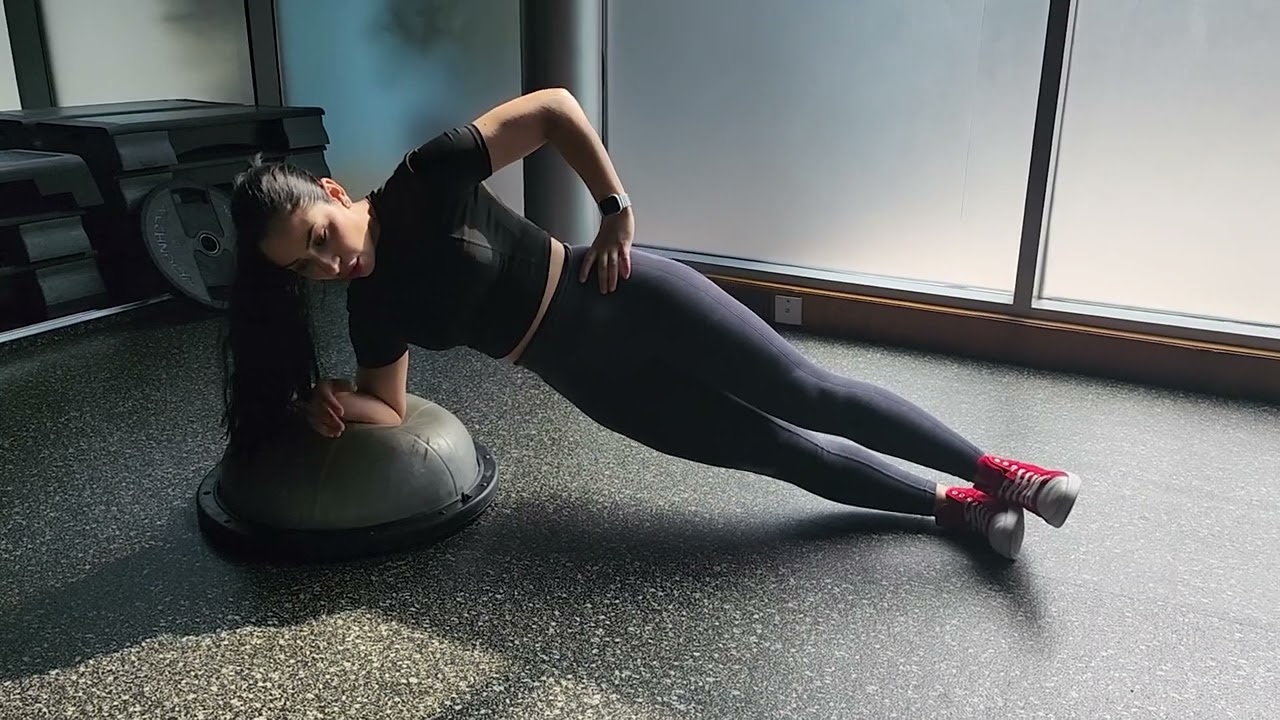
The Side Plank with Forearm on BOSU is an advanced core stability exercise that increases the challenge of a traditional side plank by placing the supporting forearm on the unstable dome of a BOSU trainer. The unstable surface forces the muscles of the core, shoulders, hips, and lower body to work continuously to maintain balance and proper alignment. Rather than creating movement, this exercise trains the body to resist movement, making it an excellent anti-lateral flexion exercise for developing functional core strength, shoulder stability, balance, and overall body control.
The primary muscle group targeted during the Side Plank with Forearm on BOSU is the abs and core, with a strong emphasis on the obliques. The internal and external obliques work continuously to prevent the torso from collapsing toward the floor, while the transverse abdominis and other deep core stabilizers brace the spine and maintain a rigid body position. Because the BOSU creates an unstable base, the core must remain engaged throughout the entire exercise to maintain proper alignment.
Several secondary muscle groups contribute to the movement. The shoulders, particularly the deltoids and rotator cuff muscles, stabilize the supporting arm against the shifting BOSU surface. The gluteus medius and gluteus maximus help maintain pelvic alignment and prevent the hips from dropping. Additional stabilizing muscles throughout the legs and trunk remain active to maintain balance, making this a true full-body stabilization exercise.
One of the greatest benefits of the Side Plank with Forearm on BOSU is its ability to improve lateral core strength. Unlike exercises that involve repeated movement, this variation teaches the body to resist side bending and maintain spinal alignment under load. Developing anti-lateral flexion strength helps improve posture, reduce unnecessary spinal movement, and enhance performance during athletic activities and everyday tasks.
Another important benefit is improved shoulder stability. Supporting your body weight on an unstable surface requires the muscles surrounding the shoulder joint to make constant adjustments. This increased stabilizer activation helps improve shoulder control, endurance, and joint stability while reinforcing proper upper-body positioning.
The Side Plank with Forearm on BOSU also enhances balance and proprioception. The unstable BOSU trainer challenges the body’s ability to react to subtle changes in position, improving neuromuscular coordination and body awareness. These improvements can transfer to better movement quality during strength training, sports, and daily activities that require balance and single-arm support.
To perform the Side Plank with Forearm on BOSU, place the BOSU dome-side up on a flat, stable surface. Position one forearm in the center of the dome with your elbow directly beneath your shoulder. Stack your feet or stagger them for additional balance if needed. Lift your hips until your body forms a straight line from your head to your feet while keeping your shoulders stacked vertically. Brace your core, squeeze your glutes, and hold the position with steady breathing while resisting any rotation or side bending. Lower under control before repeating on the opposite side.
Proper technique is essential for maximizing the effectiveness of this exercise. Keep your supporting shoulder directly above your elbow, maintain a neutral spine, and keep your hips fully elevated throughout the hold. Focus on creating full-body tension rather than simply holding the position for as long as possible. Smooth, controlled breathing helps maintain stability and prevents unnecessary tension.
Common mistakes include allowing the hips to sag, rotating the torso instead of remaining stacked, shrugging the supporting shoulder toward the ear, or placing the forearm too close to the edge of the BOSU. Some individuals also hold their breath or relax the glutes, reducing core activation and stability. Prioritizing alignment and controlled breathing produces better results than extending the hold with poor form.
From a safety perspective, this exercise is best suited for individuals who have already mastered the standard side plank on the floor. Beginners should first develop sufficient shoulder stability and core strength before progressing to the BOSU variation. If maintaining balance becomes difficult, stagger the feet or shorten the hold until stability improves.
Overall, the Side Plank with Forearm on BOSU is an excellent exercise for strengthening the obliques, improving shoulder stability, enhancing balance, and developing total-body core control. Its combination of instability and isometric strength makes it a valuable addition to functional fitness, athletic conditioning, rehabilitation progressions, and advanced core training programs.


