
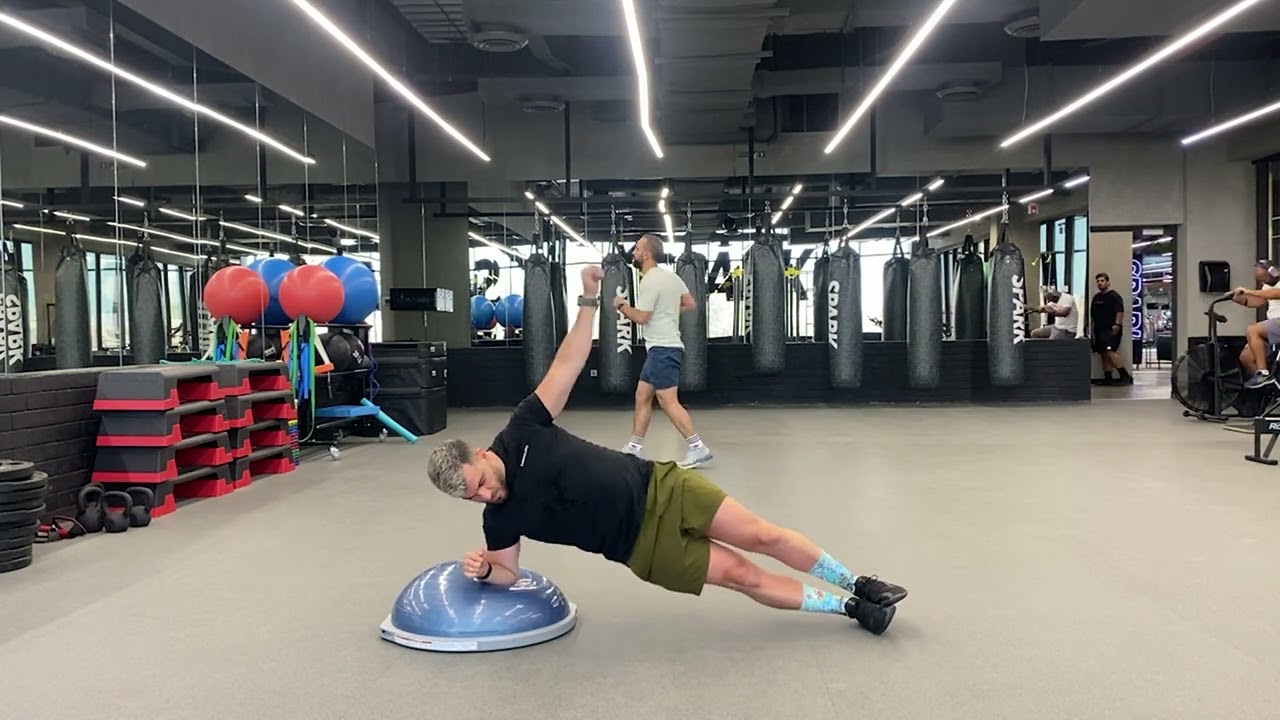
The Side Plank with Forearm on BOSU and Hip Lifts is an advanced core stability exercise that combines the anti-lateral flexion benefits of a side plank with controlled hip movement on an unstable surface. Supporting your body on a forearm positioned on the dome of a BOSU trainer significantly increases the balance challenge compared to a traditional side plank. Adding repeated hip lifts further increases the demand on the obliques, shoulders, glutes, and deep core stabilizers, making this exercise highly effective for improving lateral core strength, shoulder stability, balance, and dynamic body control.
The primary muscle group targeted during the Side Plank with Forearm on BOSU and Hip Lifts is the abs and core, with a strong emphasis on the obliques. The internal and external obliques work to lift the hips while simultaneously resisting side bending and maintaining proper trunk alignment. The transverse abdominis and other deep core stabilizers remain engaged throughout every repetition to brace the spine and prevent unnecessary movement. Because the BOSU introduces instability beneath the supporting arm, the core must work continuously to keep the body balanced.
Several secondary muscle groups play important supporting roles. The shoulders, particularly the deltoids and rotator cuff muscles, stabilize the supporting arm and shoulder joint against the shifting BOSU surface. The gluteus medius and gluteus maximus help stabilize the pelvis while assisting with the hip lift. Additional stabilizing muscles throughout the trunk, hips, and lower body remain active to maintain balance and proper alignment, making this a true full-body stabilization exercise.
One of the greatest benefits of the Side Plank with Forearm on BOSU and Hip Lifts is its ability to improve dynamic lateral core strength. Unlike a static side plank, this variation requires the core to actively move the hips while maintaining stability, helping build stronger obliques and improving the body’s ability to resist lateral movement. This type of strength is valuable for improving posture, reducing spinal stress, and enhancing performance during athletic movements and daily activities.
Another important benefit is improved hip stability and pelvic control. The glutes and hip stabilizers must coordinate with the core throughout every repetition to maintain alignment. Developing stronger hip stability can improve balance, reduce compensatory movement patterns, and contribute to better lower-body mechanics during exercises such as squats, lunges, and running.
The unstable BOSU surface also increases the demand on the shoulders and upper body. Supporting your body on an unstable forearm position requires the shoulder stabilizers to make constant adjustments, improving shoulder endurance, joint stability, and neuromuscular control. This added challenge makes the exercise more functional than performing hip lifts on the floor.
To perform the Side Plank with Forearm on BOSU and Hip Lifts, place the BOSU dome-side up on a flat, stable surface. Position one forearm in the center of the dome with your elbow directly beneath your shoulder. Stack your feet or stagger them for additional balance if needed. Lift your hips until your body forms a straight line from your head to your feet. Slowly lower your hips toward the floor while keeping your shoulders stacked and your torso facing forward. Before your lower hip touches the ground, drive your hips back upward until your body returns to a straight-line position. Complete all repetitions before switching sides.
Proper technique is essential for maximizing the effectiveness of the exercise. Keep your supporting shoulder directly above your elbow, maintain a neutral spine, and move only through the hips. Focus on smooth, controlled repetitions rather than speed, and keep your body aligned from head to heels throughout the movement. Maintaining full-body tension ensures the obliques and stabilizing muscles remain the primary focus.
Common mistakes include rotating the torso instead of moving strictly through the hips, allowing the supporting shoulder to shrug toward the ear, dropping the hips too quickly, or failing to maintain a straight side profile. Some individuals also relax the core between repetitions, reducing muscular activation and stability. Performing each repetition slowly with proper alignment produces the greatest benefit while reducing unnecessary joint stress.
From a safety perspective, this exercise is best suited for individuals who have already mastered both the standard side plank and the BOSU side plank hold. If balance becomes difficult, stagger your feet or reduce the range of motion until stability improves. Always perform the exercise on a stable, non-slip surface and prioritize quality movement over repetition count.
Overall, the Side Plank with Forearm on BOSU and Hip Lifts is an outstanding exercise for strengthening the obliques, improving shoulder stability, enhancing balance, and developing dynamic core control. Its combination of instability and controlled movement makes it one of the most effective progressions for building functional lateral strength, pelvic stability, and total-body coordination.


