The Medicine Ball Feet On Ball Glute Bridge is an effective glute-focused strength exercise that enhances hip extension power, core stability, and posterior chain activation. This variation introduces an unstable surface by placing the feet on a medicine ball, increasing muscular demand in the glutes, hamstrings, and core while promoting improved hip alignment and control. Elevating the feet shifts more of the workload into the posterior chain and forces the stabilizing muscles to work harder, making this exercise highly beneficial for strengthening the glutes, enhancing lower-body stability, and reinforcing proper hip-hinge mechanics.
As you press your heels into the ball, the instability challenges the hamstrings and deep core muscles to maintain control throughout the movement. The glutes must work harder to lift and stabilize the pelvis, making this variation more effective than a traditional floor-based bridge. This exercise also helps correct imbalances caused by overreliance on the lower back or quadriceps during other hip-dominant lifts. Because it emphasizes controlled movement and mindful positioning, it is ideal for reinforcing correct technique used in more advanced lifts like deadlifts, squats, and hip thrusts.
The Medicine Ball Feet On Ball Glute Bridge also promotes improved pelvic stability and alignment. By engaging the glutes through a full range of motion while keeping the spine neutral, the movement strengthens the muscles responsible for maintaining proper posture and reducing excessive anterior pelvic tilt. The instability of the ball requires heightened awareness, helping you build stronger neuromuscular connections between the hips and core.
This exercise suits a wide range of training goals, including strength development, warm-ups, activation drills, or rehabilitation settings where glute engagement and control are priorities. It can be scaled by adjusting the ball size, slowing the tempo, or progressing to single-leg variations for increased difficulty. Individuals who struggle to feel their glutes during traditional lifts often benefit greatly from this exercise, as the elevated and unstable position forces the glutes to activate more effectively.
To perform the exercise safely, maintain full-body tension, press through the heels, and avoid arching the lower back. Proper form ensures the glutes remain the primary drivers of the movement while the hamstrings and core provide necessary support. With consistent practice, this exercise develops stronger, more stable hips and enhances lower-body movement quality.
Overall, the Medicine Ball Feet On Ball Glute Bridge is a highly functional, efficient exercise for targeting the glutes while simultaneously improving balance, stability, and core strength. It is an excellent addition to any lower-body routine focused on performance, stability, or muscle development.
Medicine Ball Feet On Ball Glute Bridge
Glutes
How to do the Medicine Ball Feet On Ball Glute Bridge
- Primary Muscle
- Glutes
- Secondary Muscles
- Abs/CoreHamstringsLower Back
- Equipment
- Medicine Ball
- Difficulty
- Intermediate
1
Setup Instructions
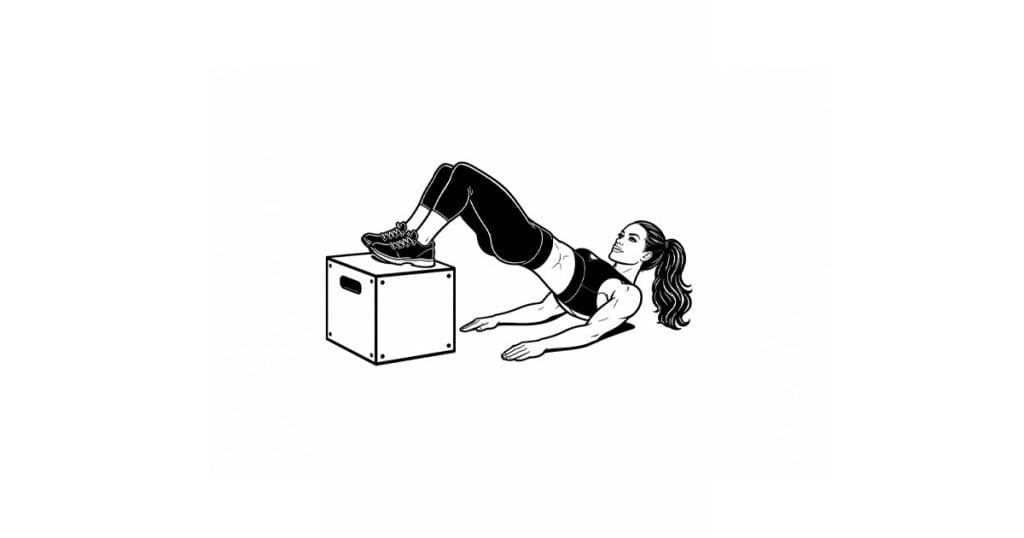
- Lie on your back with your knees bent and your heels placed on top of a medicine ball.
- Position the ball close enough so your legs form roughly a 90-degree angle when elevated.
- Place your arms at your sides with palms facing down for stability.
- Engage your core and lightly tuck your pelvis to keep the spine neutral.
2
Coaching Cues
- Drive through the heels to activate the glutes more effectively.
- Keep the medicine ball as still as possible for added core engagement.
- Avoid overextending the lower back—stop when the glutes are fully contracted.
- Lift and lower the hips slowly to maximize tension and stability.
3
Execution Steps
- Press your heels into the medicine ball and begin lifting your hips off the floor.
- Squeeze your glutes at the top until your body forms a straight line from shoulders to knees.
- Hold briefly at full hip extension, maintaining tension in the glutes and hamstrings.
- Lower your hips slowly and under full control back toward the ground without fully resting.
- Repeat for the desired number of repetitions while keeping the ball stable and hips aligned.
4
Common Mistakes
- Pushing through the toes instead of the heels, reducing glute activation.
- Arching the lower back at the top instead of squeezing the glutes.
- Letting the ball roll excessively, causing loss of form.
- Dropping the hips too quickly without control.
5
Safety Notes
- Start with a smaller or heavier medicine ball for increased stability if needed.
- Keep movements slow to avoid strain on the lower back.
- If discomfort occurs in the knees, adjust the ball position or reduce the range of motion.
6
Also Known As
- Med Ball Glute Bridge
- Feet-Elevated Glute Bridge on Ball
Same Muscle Group