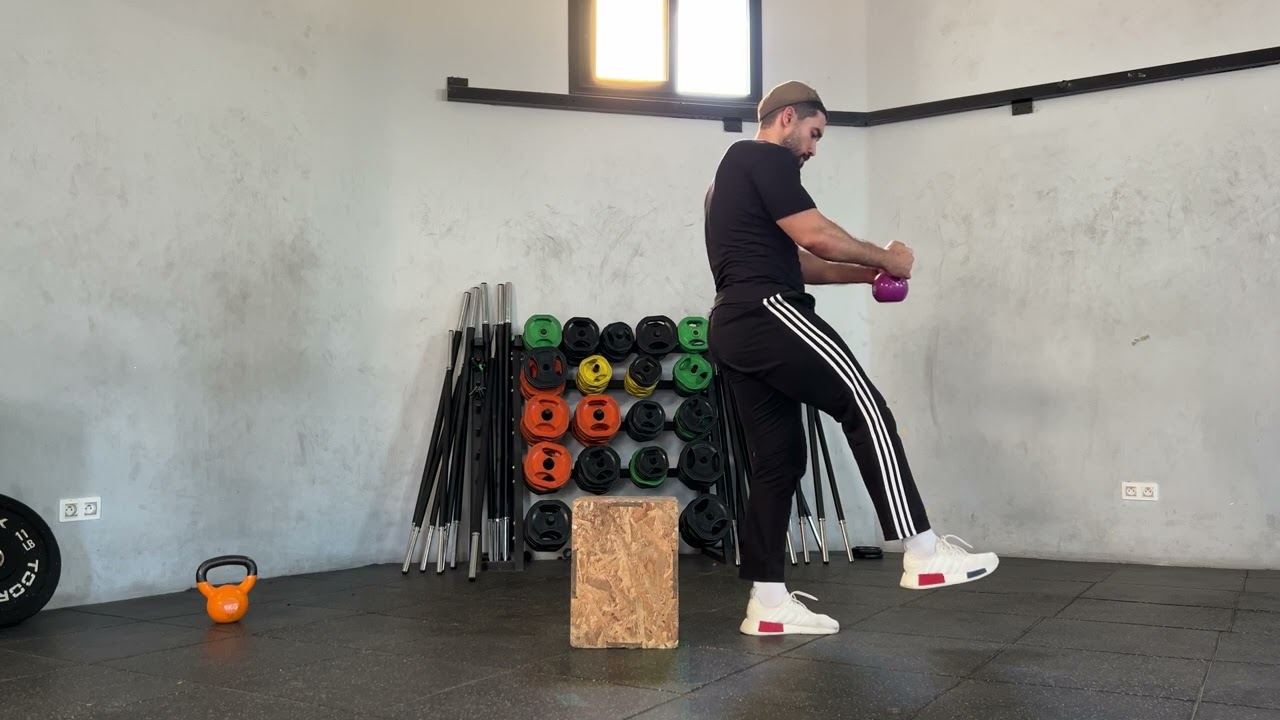
Kettlebell Pistol Squat to Box

  • MuscleQuads
  • EquipmentBox, Kettlebell
  • LevelAdvanced

Muscles worked

Kettlebell Pistol Squat to Box
ChestObliquesAbsBicepsTricepsNeckFront deltsAdductorsQuadsCalvesForearms
Front
TrapsRear deltsUpper backTricepsLower backForearmsGlutesHip abductorsHamstringsCalvesCalvesCalves
Back
PrimarySecondary
Exercise guide

How to do the Kettlebell Pistol Squat to Box

The Kettlebell Pistol Squat to Box is an advanced unilateral lower-body strength exercise that combines a single-leg squat with a controlled descent onto a box. The movement primarily targets the quadriceps while engaging the glutes, hamstrings, calves, hip flexors, and core. Holding a kettlebell in front of the chest adds resistance while the box provides a consistent depth target. This exercise develops single-leg strength, balance, coordination, and controlled squat mechanics.

Unlike a traditional bilateral squat, the Kettlebell Pistol Squat to Box requires one leg to support nearly the entire body weight and kettlebell resistance. The opposite leg remains extended forward throughout the movement. This creates greater demands on the supporting quadriceps and glutes while requiring the ankle, hip, and core muscles to maintain stability.

The box serves as a controlled stopping point during the lowering phase. It allows the exercise to be performed at a depth appropriate for the individual’s strength, balance, and mobility. A higher box reduces the required squat depth, while a lower box increases the range of motion and generally makes the movement more challenging.

To perform the Kettlebell Pistol Squat to Box, begin by placing a stable box or bench on a flat surface. Stand directly in front of it with your back facing the box. Hold one kettlebell securely with both hands in front of your chest. Keep your elbows comfortably bent and maintain an upright torso.

Shift your body weight onto one leg and lift your opposite foot off the floor. Extend the non-working leg forward while keeping your supporting foot firmly planted. Engage your abdominal muscles and establish balance before beginning the squat. Your supporting knee should remain aligned in the same general direction as your toes.

Initiate the movement by bending the knee and hip of your supporting leg. Slowly lower your hips backward and downward toward the box. Allow your torso to lean slightly forward as needed to maintain balance. Keep the kettlebell close to your chest and avoid allowing your upper body to rotate excessively.

Continue lowering until your glutes lightly contact the box. Maintain muscular tension rather than dropping onto the surface. Your non-working leg should remain elevated and extended forward. Avoid placing your free foot on the floor to assist with balance unless you are intentionally performing a modified variation.

Pause briefly at the bottom while maintaining control of your supporting leg. To return to standing, push firmly through your supporting foot and extend your knee and hip. Keep your core engaged and avoid rocking your torso excessively to generate momentum. Continue rising until your supporting leg reaches a comfortable extended position.

Finish standing tall while keeping your non-working foot elevated. Reestablish balance before beginning another repetition. Perform the movement with consistent control, then switch legs to train the opposite side.

The quadriceps are the primary muscles involved in the Kettlebell Pistol Squat to Box. They control knee flexion during the descent and generate force to extend the knee during the standing phase. Because the movement is performed on one leg, the quadriceps experience substantial loading even when a relatively light kettlebell is used.

The glutes contribute to hip extension and help stabilize the pelvis throughout the squat. The hamstrings assist with lower-body stabilization, while the calves support ankle control and balanced foot pressure. The hip flexors help maintain the non-working leg in its elevated position.

The abdominal muscles and obliques stabilize the torso as the body moves through the single-leg squat. Maintaining core tension helps control excessive spinal movement and supports balance. The forearms also contribute by maintaining a secure grip on the kettlebell.

One common mistake is dropping onto the box instead of lowering under control. This reduces muscular tension and can create an abrupt impact. Focus on gradually lowering your hips until they lightly contact the surface. The box should act as a depth reference rather than a place to collapse or rest completely.

Another common mistake is allowing the supporting knee to collapse inward. Maintain balanced pressure through your foot and keep your knee tracking naturally with your toes. Avoid forcing the knee excessively outward, as controlled alignment is more important than exaggerated positioning.

Using a box that is too low can also compromise technique. Excessive depth may cause the supporting heel to lift, the lower back to round, or the body to lose balance. Select a height that allows the movement to be completed without sacrificing control.

The Kettlebell Pistol Squat to Box differs from a standard Kettlebell Pistol Squat because the box establishes a consistent stopping point. It also differs from a traditional Kettlebell Box Squat because the movement is performed on one supporting leg rather than two.

Overall, the Kettlebell Pistol Squat to Box is an effective exercise for developing quadriceps strength, unilateral lower-body control, balance, and coordination. When performed with appropriate resistance, a stable box, controlled movement, and proper knee alignment, it provides a challenging way to strengthen the legs while improving single-leg squat mechanics.

About this guide
Written byTeam Exercise Library
Reviewed byDr. Jaime Alnassim
Updated
01

Setup

10
  • Select one kettlebell that allows controlled single-leg squatting.
  • Position a stable box or bench on a flat, non-slip surface.
  • Choose a box height that allows you to lower yourself without losing balance or control.
  • Stand directly in front of the box with your back facing it.
  • Hold the kettlebell securely with both hands in front of your chest.
  • Shift your weight onto one leg and establish a stable standing position.
  • Lift your opposite foot slightly off the floor and extend that leg forward.
  • Keep your supporting foot firmly planted with your knee aligned over your toes.
  • Brace your core and maintain an upright, controlled torso.
  • Ensure the box is positioned directly behind your hips before beginning.
02

Execution steps

15
  1. Begin standing on one leg with the kettlebell held securely in front of your chest.
  2. Extend your non-working leg forward and keep it elevated above the floor.
  3. Brace your core and maintain balanced pressure through your supporting foot.
  4. Initiate the squat by bending the knee and hip of your supporting leg.
  5. Lower your hips backward and downward toward the box.
  6. Keep your non-working leg extended forward without allowing it to touch the floor.
  7. Allow your torso to lean slightly forward as needed to maintain balance.
  8. Keep your supporting knee aligned in the same general direction as your toes.
  9. Continue lowering until your glutes lightly contact the box.
  10. Pause briefly without collapsing onto the box or completely relaxing your supporting leg.
  11. Push through your supporting foot to extend your knee and hip.
  12. Rise to a standing position while keeping your opposite leg elevated.
  13. Finish standing tall with your supporting knee and hip extended.
  14. Repeat with controlled technique before switching legs.
  15. Carefully return the kettlebell to a safe resting position after completing the exercise.
03

Coaching cues

14
  • Keep your supporting foot firmly planted.
  • Hold the kettlebell close to your chest.
  • Extend your free leg forward.
  • Brace your core throughout the movement.
  • Lower your hips toward the box with control.
  • Keep your supporting knee aligned with your toes.
  • Maintain balanced pressure through your foot.
  • Use a slight forward torso lean when needed.
  • Touch the box lightly without collapsing.
  • Avoid rocking backward to stand.
  • Drive through your supporting leg.
  • Keep your free foot off the floor.
  • Stand tall at the top.
  • Control both the lowering and lifting phases.
04

Common mistakes

14
  • Using a kettlebell that is too heavy to control.
  • Choosing a box that is too low for available strength or mobility.
  • Allowing the supporting heel to lift from the floor.
  • Allowing the supporting knee to collapse inward.
  • Dropping quickly onto the box.
  • Relaxing completely while seated on the box.
  • Rocking the torso excessively to generate momentum.
  • Allowing the non-working foot to touch the floor.
  • Rounding the lower back excessively during the descent.
  • Leaning excessively to one side.
  • Holding the kettlebell too far away from the body.
  • Pushing through the non-working leg to assist the movement.
  • Failing to control the transition between sitting and standing.
  • Attempting a greater range of motion than can be performed safely.
05

Safety notes

13
  • Develop adequate bodyweight single-leg squat strength and balance before adding kettlebell resistance.
  • Begin with a light kettlebell and a box height that allows controlled movement.
  • Ensure the box is stable and cannot slide or tip.
  • Position the box directly behind your hips before beginning.
  • Maintain a secure two-handed grip on the kettlebell.
  • Keep your supporting foot firmly planted throughout the movement.
  • Maintain knee alignment and avoid uncontrolled inward collapse.
  • Lower yourself gradually rather than dropping onto the box.
  • Avoid completely relaxing your supporting leg when contacting the box.
  • Use a comfortable range of motion without forcing excessive knee or ankle flexion.
  • Maintain core engagement and avoid excessive spinal rounding.
  • Stop if you experience sharp pain in your knees, hips, ankles, or lower back.
  • Carefully place both feet on the floor before lowering the kettlebell.

This article is for general education, not medical advice. If you have pain or an injury, check with a doctor or physical therapist before starting a new exercise.

Also known as
Kettlebell Box Pistol SquatWeighted Pistol Squat to BoxKettlebell Single-Leg Box SquatKettlebell Assisted-Depth Pistol SquatKettlebell Pistol Box Squat

This website uses cookies to enhance your browsing experience and ensure the site functions properly. By continuing to use this site, you acknowledge and accept our use of cookies.

Accept All Accept Required Only