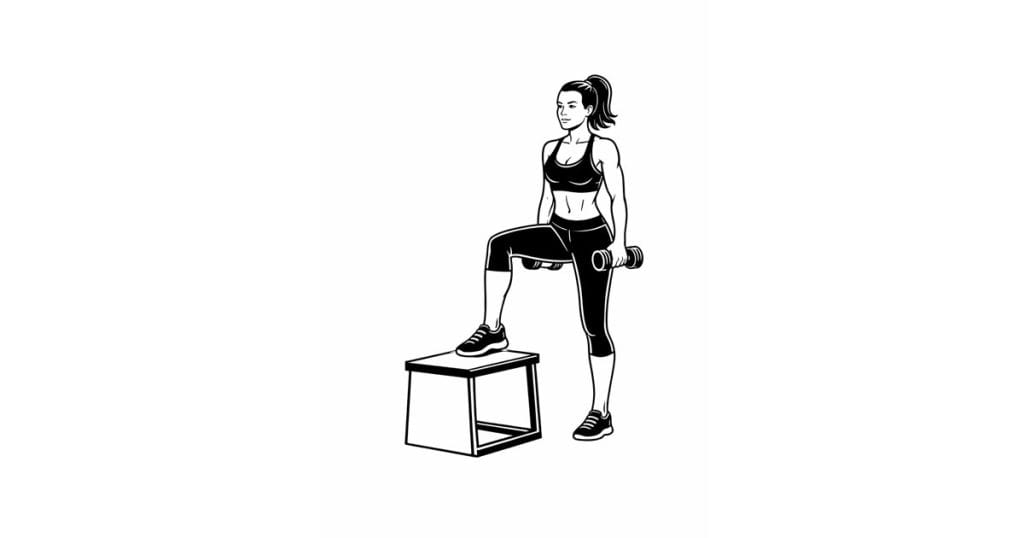
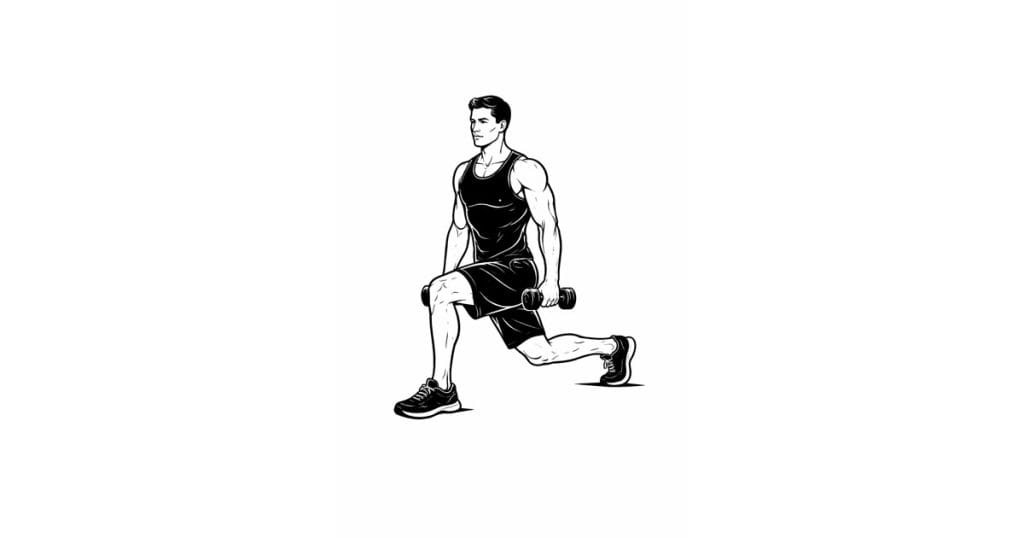
The Kettlebell Lunge to Curl is a compound strength exercise that combines a forward lunge with a standing biceps curl. The movement primarily targets the quadriceps while engaging the glutes, hamstrings, biceps, forearms, core, calves, and adductors. By combining lower-body and upper-body movements, the exercise challenges muscular strength, balance, coordination, and stability while requiring controlled movement through multiple joints.
The Kettlebell Lunge to Curl is performed by stepping forward into a lunge, maintaining the lowered position, curling the kettlebells toward the shoulders, and returning to standing. This sequence allows the lower body to support the position while the biceps perform a separate curling movement. The exercise requires coordination between the legs, arms, and core to maintain balance throughout each repetition.
To perform the Kettlebell Lunge to Curl, begin standing tall with your feet approximately hip-width apart. Hold one kettlebell in each hand with your arms resting naturally at your sides. Keep your palms facing forward or slightly inward, depending on the handle position that feels most comfortable. Maintain a secure grip, brace your abdominal muscles, and keep your shoulders relaxed.
Take a controlled step forward with one leg while maintaining enough space between your feet for balance. Bend both knees to lower your body into a forward lunge. Your front knee should track in the same general direction as your toes, while your rear knee moves toward the floor. Descend only as far as you can maintain proper control and comfortable joint positioning.
Once you reach the bottom of the lunge, stabilize your torso and prepare to perform the curl. Keep your upper arms relatively close to your body and bend your elbows to raise the kettlebells toward your shoulders. Avoid swinging the weights or leaning backward to generate momentum. The curling motion should come primarily from elbow flexion rather than excessive movement through the shoulders or torso.
At the top of the curl, briefly maintain control of the kettlebells while keeping your balance. Slowly extend your elbows to lower the weights back toward your sides. Once your arms have returned to the starting position, push firmly through your front foot to extend your front knee and hip, returning to standing.
Repeat the movement with the opposite leg, maintaining the same controlled sequence. Each repetition should include a stable forward lunge, deliberate biceps curl, controlled lowering phase, and balanced return to standing. Avoid rushing between movements, as maintaining proper positioning is important for both strength development and coordination.
The quadriceps are the primary muscles involved in the lunge portion. They control knee flexion during the descent and produce knee extension as the body returns to standing. Because the movement is performed one leg at a time, each leg must independently support and move the body against gravity and the additional kettlebell resistance.
The glutes assist with hip extension during the upward phase and help stabilize the pelvis throughout the lunge. The hamstrings contribute to hip control and lower-body stability, while the adductors assist with maintaining proper thigh positioning. The calves help stabilize the ankles as the body moves between standing and lunging positions.
The biceps are responsible for the curling portion of the exercise. During the curl, the biceps and other elbow flexors shorten to raise the kettlebells toward the shoulders. They then control the weights during the lowering phase. The forearms contribute by maintaining a secure grip and stabilizing the wrists throughout the movement.
The core muscles play an important role in maintaining balance and controlling torso movement. Holding a lunge while curling kettlebells creates additional demands on trunk stability because the weights move relative to the body. Keeping the abdominal muscles engaged helps prevent excessive leaning, twisting, or unnecessary movement during the curl.
One common mistake is using kettlebells that are too heavy. Because the exercise combines a lower-body movement with a biceps curl, the weight must be manageable for both components. A kettlebell that feels appropriate for lunges may be too heavy for controlled curling. Choose resistance that allows smooth elbow flexion without swinging or compromising balance.
Another common mistake is leaning backward during the curl. This often occurs when the kettlebells are too heavy or the core is not sufficiently engaged. Excessive leaning changes the movement and can place unnecessary stress on the lower back. Maintain a stable torso and allow the elbows to perform the curling action.
Poor foot positioning can also reduce stability. Stepping directly in line with the rear foot creates a narrow base of support and makes balancing more difficult. Maintain approximately hip-width spacing between the feet while choosing a step length that allows both knees to bend comfortably.
The Kettlebell Lunge to Curl differs from a traditional Kettlebell Lunge because it adds an upper-body pulling movement while the lower body maintains an isometric lunge position. It also differs from a standard standing kettlebell curl because the biceps work while the legs and core stabilize the body in a split stance.
The exercise can also be performed with one kettlebell instead of two. A single-kettlebell variation increases the demand on the core to resist sideways leaning, while the two-kettlebell version provides more balanced resistance. Regardless of the variation, the movement should remain controlled and the curl should not interfere with proper lunge mechanics.
Overall, the Kettlebell Lunge to Curl is an effective exercise for developing lower-body strength, biceps strength, coordination, and balance. When performed with appropriate resistance, stable knee alignment, controlled elbow movement, secure kettlebell positioning, and a deliberate return to standing, it provides a practical combination of unilateral leg training and upper-body strengthening.