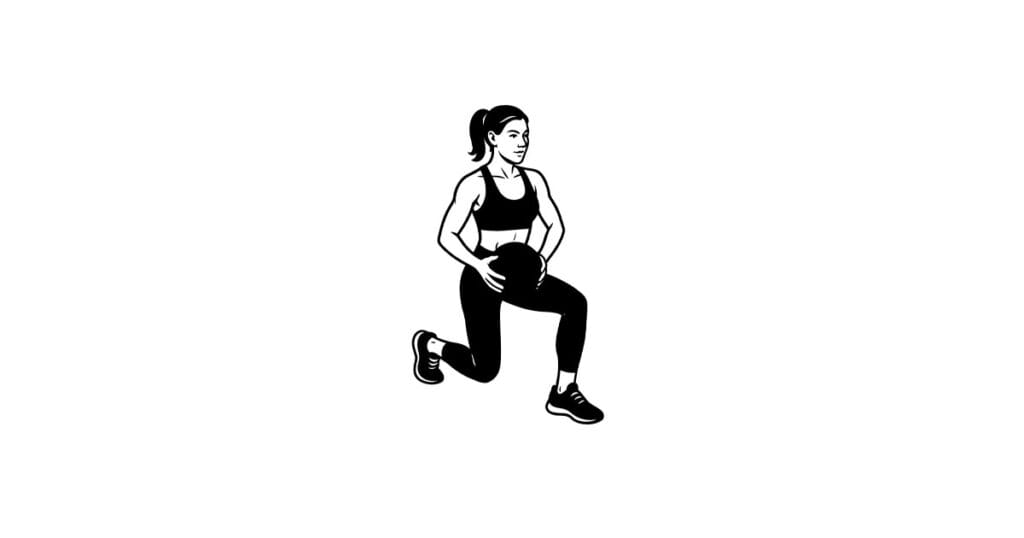
The Kettlebell Goblet Squat is a fundamental lower-body strength exercise performed while holding a single kettlebell close to the chest. The quads are the primary muscle group worked, while the glutes, hamstrings, adductors, core, calves, forearms, and upper back contribute to producing force and maintaining proper posture. The front-loaded position provides a natural counterbalance and makes the exercise a useful way to develop squat strength, control, and technique.
To perform the Kettlebell Goblet Squat, stand with your feet approximately shoulder-width apart. Hold one kettlebell securely at your chest with both hands. Depending on the kettlebell and your preferred grip, you can support the weight around the sides of the handle or near the horns. Keep the kettlebell close to your torso rather than extending it forward.
Turn your toes slightly outward if needed to create a comfortable squat stance. Individual stance width and foot angle can vary based on hip structure, mobility, and body proportions. Keep your entire foot in contact with the floor and establish balanced pressure across the heel, forefoot, and outside edge of each foot.
Before descending, brace your abdominal muscles and establish a stable torso. Begin the squat by bending your knees and hips together. Lower your hips down between your legs while maintaining control of the kettlebell. Your knees should track in the same general direction as your toes as you descend.
Continue lowering until you reach a comfortable squat depth. The exact depth will vary between individuals depending on hip and ankle mobility, limb proportions, and experience. Squat only as deeply as you can while maintaining stable feet, controlled knee alignment, and a strong torso position. Avoid forcing additional depth if your heels begin to lift or your posture changes significantly.
At the bottom of the Kettlebell Goblet Squat, maintain muscular tension rather than relaxing into the position. Keep your core braced and the kettlebell close to your chest. From this position, drive through your feet and begin extending your knees and hips. Continue rising until you return to a tall standing position.
At the top, finish with your hips and knees extended while maintaining a neutral torso. Avoid aggressively pushing the hips forward or leaning backward. The finish should resemble a natural standing posture with the glutes engaged and the core controlled.
The quads contribute significantly to the Kettlebell Goblet Squat because they control knee flexion during the descent and extend the knees as you stand. The glutes contribute to hip extension, particularly when rising from deeper squat positions. The hamstrings and adductors assist with hip control and contribute to maintaining stable lower-body mechanics.
The front-loaded kettlebell also creates a meaningful core challenge. The abdominal muscles work to stabilize the torso and prevent excessive movement through the spine. The upper back helps maintain an upright posture, while the forearms and hands support the kettlebell throughout each repetition.
A major benefit of the goblet position is that the kettlebell acts as a counterbalance. Holding the weight in front of the torso can make it easier to sit between the hips while maintaining balance compared with some other loaded squat variations. However, the kettlebell should remain close to the body. Holding it too far forward increases the demand on the arms and can pull the torso out of position.
A common mistake is allowing the knees to collapse inward during the descent or ascent. Maintain stable foot pressure and keep the knees tracking with the toes. The knees can naturally move forward during a squat, provided the feet remain planted and the movement is comfortable and controlled.
Another common error is shifting excessively onto the toes and allowing the heels to rise. Keep your entire foot connected to the floor. Some forward movement of the knees is normal, but balance should remain controlled rather than shifting completely toward the front of the feet.
Torso position will vary depending on individual proportions. A perfectly vertical torso is not required, and some forward inclination is normal. However, avoid allowing the upper or lower back to round excessively. Keep the core braced and maintain a strong spinal position throughout the movement.
The Kettlebell Goblet Squat differs from the double Kettlebell Front Squat because it uses one kettlebell held centrally at the chest rather than two kettlebells supported independently in the front rack position. The single centered load simplifies the upper-body setup while still providing external resistance and a substantial challenge to the lower body and core.
Move through each repetition with control. Avoid dropping rapidly into the bottom position or bouncing upward without maintaining tension. A smooth descent and controlled drive back to standing make it easier to maintain consistent knee, hip, and spinal positioning throughout the exercise.
Overall, the Kettlebell Goblet Squat is an effective compound strength exercise for developing the quads, glutes, and supporting lower-body muscles while reinforcing squat mechanics and core stability. Its centered front-loaded position provides a straightforward way to add resistance to the squat pattern. When performed with stable feet, controlled knee alignment, a braced core, secure kettlebell position, and comfortable squat depth, the Kettlebell Goblet Squat provides an effective way to develop lower-body strength and movement control.