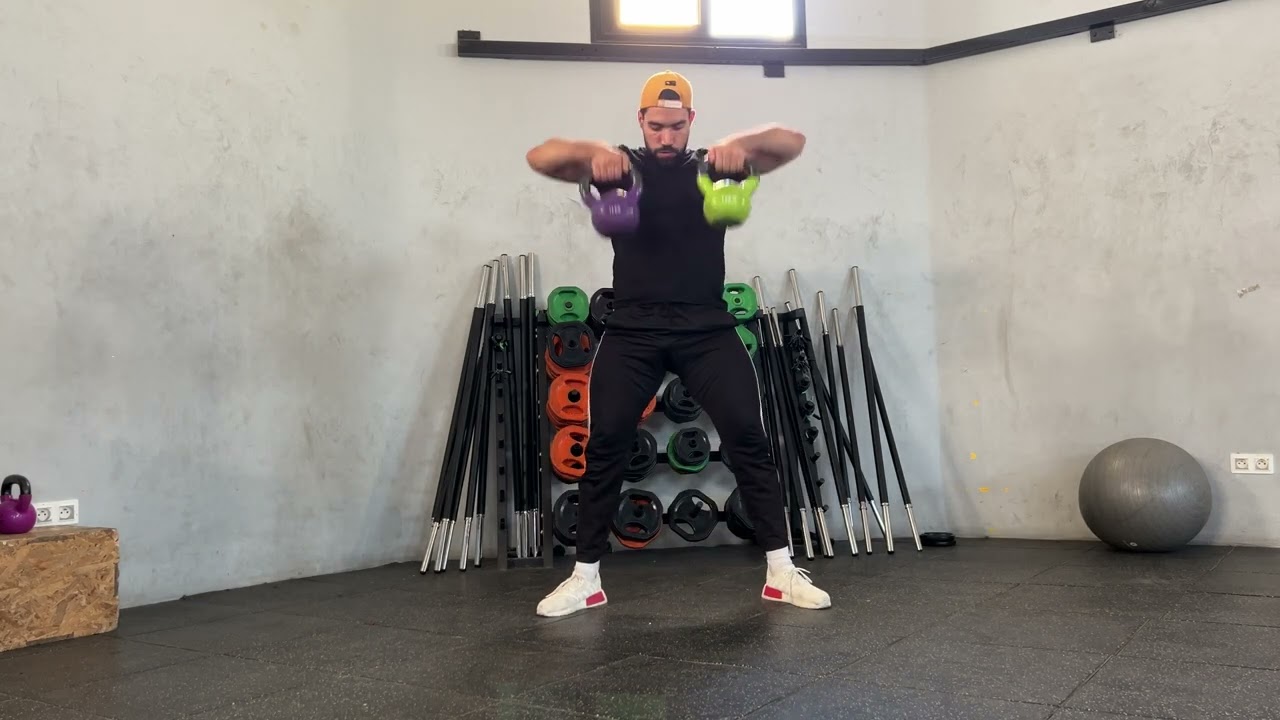
Double Kettlebell Sumo High Pull

  • MuscleFull Body
  • EquipmentKettlebell
  • LevelAdvanced

Muscles worked

Double Kettlebell Sumo High Pull
ChestObliquesAbsBicepsTricepsNeckFront deltsAdductorsQuadsCalvesForearms
Front
TrapsRear deltsUpper backTricepsLower backForearmsGlutesHip abductorsHamstringsCalvesCalvesCalves
Back
PrimarySecondary
Exercise guide

How to do the Double Kettlebell Sumo High Pull

The Double Kettlebell Sumo High Pull is an advanced compound strength and power exercise that combines a wide-stance double kettlebell deadlift with an explosive upper-body pulling movement. The exercise begins with two kettlebells positioned between the feet, one held in each hand. The athlete drives upward through the hips and legs before guiding both kettlebells toward the upper abdomen or lower chest. The movement trains the glutes, quadriceps, hamstrings, adductors, shoulders, trapezius, and upper-back muscles while requiring coordinated full-body movement.

The Double Kettlebell Sumo High Pull is a more demanding variation of the single-kettlebell sumo high pull. Instead of holding one kettlebell with both hands, the athlete holds two independent kettlebells. This increases the potential total resistance while introducing additional grip, shoulder stabilization, and coordination demands. Both kettlebells must move in a controlled and symmetrical manner throughout the exercise.

To perform the Double Kettlebell Sumo High Pull, begin by placing two kettlebells side by side on the floor between your feet. Stand wider than shoulder-width apart and turn your toes outward to a comfortable angle. Adjust your stance so that both kettlebells can move freely between your legs without striking your feet or knees.

Brace your abdominal muscles and push your hips backward while bending your knees. Lower your torso toward the kettlebells while maintaining a neutral spine. Grasp one kettlebell handle with each hand using a neutral grip. Keep your arms extended and position your shoulders above or slightly in front of the weights.

Initiate the movement by driving forcefully through the floor and extending your hips and knees together. The initial upward movement should be generated primarily by the lower body rather than the arms. As both kettlebells rise and your hips approach full extension, begin bending your elbows to guide the weights upward.

Pull both kettlebells toward your upper abdomen or lower chest while keeping them close to your body. Allow your elbows to move outward and upward within a comfortable range of shoulder motion. Avoid forcing the kettlebells excessively high toward your chin or pulling your elbows into an uncomfortable position. Maintain a stable torso without leaning backward.

After reaching the top of the high pull, guide both kettlebells downward under control. Extend your elbows as the weights descend, then push your hips backward and bend your knees to return the kettlebells toward the floor. Maintain a neutral spine and stable knee alignment throughout the lowering phase. Repeat the movement using a coordinated lower-body drive followed by a controlled upper-body pull.

The gluteus maximus is one of the primary muscles responsible for generating force during the initial lifting phase. As the hips extend, the glutes help accelerate the body upward and contribute to the momentum transferred to the kettlebells. The quadriceps simultaneously extend the knees, allowing the athlete to rise from the wide-stance starting position.

The hamstrings contribute to hip extension and lower-body stability, while the adductor magnus assists with hip extension from the sumo stance. Other adductor muscles help control thigh positioning and maintain stable knee and hip alignment. Together, these muscles support the lower-body drive that initiates the movement.

The trapezius and deltoid muscles contribute to the upper-body pulling phase. As the kettlebells move upward, the shoulders and upper-back muscles help guide the weights and stabilize the shoulder girdle. The biceps and other elbow flexors assist with bending the elbows, while the forearm muscles maintain a secure grip on both kettlebell handles.

The abdominal muscles and spinal stabilizers work throughout the movement to maintain trunk alignment. The erector spinae help resist excessive spinal flexion, while the abdominal muscles contribute to trunk stiffness and control. Maintaining a stable torso allows force generated by the lower body to be transferred more efficiently through the upper body.

One of the main benefits of the Double Kettlebell Sumo High Pull is its emphasis on coordinated full-body power. The exercise requires the athlete to generate force through the legs and hips before transitioning into an upper-body pulling action. This sequencing develops coordination between the lower and upper body and can be useful in athletic conditioning programs.

Another benefit is the involvement of multiple major muscle groups within a single repetition. The lower body produces the initial drive, while the shoulders and upper back contribute to the high pull. The trunk stabilizers maintain posture, and the grip muscles support the kettlebells throughout the movement. This makes the exercise suitable for full-body training circuits when performed with appropriate technique and resistance.

The use of two kettlebells also increases the demand for symmetrical movement. Each arm must control its own weight, and the athlete must prevent the kettlebells from moving at different speeds or colliding. This requires additional coordination and shoulder stability compared with the single-kettlebell variation.

The exercise can also provide a cardiovascular conditioning challenge when performed for repeated controlled repetitions. Because several large muscle groups are involved, repeated sets may elevate heart rate and increase overall muscular demand. However, maintaining technique should take priority over performing repetitions as quickly as possible.

A common mistake is initiating the high pull primarily with the arms. When the athlete begins bending the elbows before completing the lower-body drive, the exercise becomes more similar to an upright row and reduces the contribution of the hips and legs. Focus on generating upward momentum through coordinated hip and knee extension before using the arms to guide the kettlebells.

Another common mistake is pulling the kettlebells excessively high. Attempting to bring the weights toward the chin can encourage uncomfortable shoulder positioning, particularly when the elbows are raised excessively high. The appropriate pulling height depends on shoulder mobility, individual anatomy, and control. A lower, comfortable pulling range is preferable to forcing additional height.

Using excessive resistance can also compromise technique. Kettlebells that are too heavy may cause the athlete to jerk the weights upward, lean backward, or use uncontrolled shoulder movement. Begin with light resistance and increase the load only when the lower-body drive and high pull can be performed smoothly.

The Double Kettlebell Sumo High Pull differs from the Double Kettlebell Sumo Deadlift because it includes an additional upper-body pulling phase. The standard sumo deadlift focuses on raising the kettlebells from the floor through hip and knee extension, while the high-pull variation uses the momentum generated by the lower body to continue moving the weights upward.

It also differs from the single Kettlebell Sumo High Pull because the athlete must manage two independent kettlebells rather than one centrally held weight. This increases the demands on grip strength, shoulder stabilization, and coordinated arm movement. The double variation may also allow greater total resistance, although heavier loading should not compromise movement quality.

Compared with the Double Kettlebell Swing, the sumo high pull uses a more vertical lifting path and incorporates active elbow flexion during the upper-body phase. The kettlebell swing primarily relies on a powerful hip hinge to project the weights forward and upward, with the arms functioning mainly as connectors. The sumo high pull combines lower-body extension with a more deliberate pulling action.

For beginners, the double kettlebell sumo deadlift and single-kettlebell sumo high pull are appropriate preparatory exercises. Once the athlete can maintain a stable wide stance, neutral spine, coordinated hip and knee extension, and comfortable shoulder mechanics, the double high-pull variation can be introduced using lightweight kettlebells.

More experienced athletes can incorporate the Double Kettlebell Sumo High Pull into full-body strength workouts, power-focused sessions, and functional fitness circuits. It can be performed for moderate repetitions with an emphasis on explosive lower-body extension and controlled kettlebell movement. Because the exercise involves a dynamic shoulder pull and two independently moving weights, resistance and repetition volume should be selected carefully to avoid unnecessary fatigue-related technique breakdown.

Overall, the Double Kettlebell Sumo High Pull is a challenging compound exercise that develops lower-body power, upper-body pulling strength, grip endurance, and full-body coordination. When performed with an appropriate stance, strong hip and knee extension, controlled shoulder mechanics, and manageable resistance, it provides an advanced addition to a comprehensive strength and conditioning program.

About this guide
Written byTeam Exercise Library
Reviewed byDr. Jaime Alnassim
Updated
01

Setup

34
  • Select two kettlebells of equal weight that allow you to perform explosive hip and knee extension followed by a controlled high pull.
  • Begin with substantially lighter kettlebells than you would normally use for a double kettlebell sumo deadlift.
  • Choose a flat, stable, non-slip training surface.
  • Ensure there is sufficient space around your body to perform the movement safely.
  • Place both kettlebells on the floor between your feet.
  • Position the kettlebells side by side with enough clearance to prevent them from striking each other.
  • Orient the handles so you can grasp one kettlebell securely in each hand using a neutral grip.
  • Stand with your feet wider than shoulder-width apart.
  • Adjust your stance width according to your hip mobility, leg length, and the combined width of the kettlebells.
  • Turn your toes outward approximately 20 to 45 degrees or to a comfortable angle that allows your knees to track naturally.
  • Keep your heels firmly planted on the floor.
  • Distribute your weight evenly through the heel, base of the big toe, and base of the little toe of each foot.
  • Position both kettlebells approximately beneath your torso.
  • Keep the kettlebells centered between your legs rather than excessively forward of your body.
  • Stand tall with your rib cage aligned above your pelvis.
  • Brace your abdominal muscles before reaching toward the kettlebells.
  • Initiate the setup by pushing your hips backward while bending your knees.
  • Allow your knees to move outward in line with your toes.
  • Lower your torso toward the kettlebells while maintaining a neutral spine.
  • Keep your chest comfortably open without excessively arching your lower back.
  • Reach down and grasp one kettlebell handle with each hand.
  • Maintain a neutral grip with your palms facing inward.
  • Keep your wrists in a comfortable neutral position.
  • Keep your arms extended at the bottom of the movement.
  • Position your shoulders above or slightly in front of the kettlebells.
  • Engage your upper-back muscles to maintain stable shoulder positioning.
  • Keep your head and neck aligned with your spine.
  • Maintain a comfortable forward and downward gaze.
  • Ensure your knees remain aligned with your toes.
  • Establish even tension through both arms before beginning the lift.
  • Prepare to initiate the movement through coordinated hip and knee extension.
  • Plan to pull both kettlebells upward only after the lower body has generated upward momentum.
  • Choose a high-pull range that allows comfortable shoulder movement without forcing the elbows excessively high.
  • Prepare to lower both kettlebells under control before beginning the next repetition.
02

Execution steps

44
  1. Begin standing in a wide sumo stance with two kettlebells positioned side by side on the floor between your feet.
  2. Turn your toes slightly outward according to your natural hip mobility.
  3. Maintain stable pressure through both feet.
  4. Brace your abdominal muscles before beginning the movement.
  5. Push your hips backward and bend your knees to lower toward the kettlebells.
  6. Keep your knees tracking in the same direction as your toes.
  7. Maintain a neutral spine throughout the setup.
  8. Grasp one kettlebell handle with each hand using a neutral grip.
  9. Keep your arms extended and your shoulders stable.
  10. Position both kettlebells directly beneath your torso.
  11. Engage your glutes, quadriceps, and upper-back muscles before initiating the lift.
  12. Begin the upward movement by driving forcefully through the floor.
  13. Extend your knees and hips together to accelerate your body upward.
  14. Keep both kettlebells close to your center of mass as they leave the floor.
  15. Allow the kettlebells to gain upward momentum from the powerful lower-body extension.
  16. Maintain abdominal tension as your torso rises.
  17. Keep both kettlebells moving at approximately the same speed.
  18. Once your hips and knees approach full extension, begin bending your elbows to guide both kettlebells upward.
  19. Pull the kettlebells vertically toward your upper abdomen or lower chest.
  20. Allow your elbows to move outward and upward within a comfortable shoulder range.
  21. Keep the kettlebells close to the front of your body.
  22. Maintain enough separation between the kettlebells to prevent them from colliding.
  23. Avoid pulling the kettlebells excessively high toward your chin.
  24. Maintain stable shoulder positioning without forcing uncomfortable internal rotation.
  25. Keep your wrists in a comfortable position throughout the pull.
  26. Finish the upward phase with your hips and knees extended and your torso upright.
  27. Avoid leaning backward to increase the height of the pull.
  28. Briefly control both kettlebells near the top of the movement.
  29. Begin the lowering phase by allowing your elbows to extend under control.
  30. Guide both kettlebells downward close to your body.
  31. Avoid allowing the kettlebells to swing excessively away from your torso.
  32. As the kettlebells descend, push your hips backward and bend your knees.
  33. Maintain a neutral spine during the lowering phase.
  34. Keep your knees aligned with your toes.
  35. Lower both kettlebells toward the floor between your feet.
  36. Maintain even loading through both arms.
  37. Allow both kettlebells to touch the floor gently or return to a controlled low position according to the chosen repetition style.
  38. Avoid bouncing the kettlebells off the floor.
  39. Reestablish abdominal tension and stable foot pressure before the next repetition.
  40. Repeat the movement using a powerful lower-body drive followed by a controlled high pull.
  41. Maintain symmetrical movement and consistent shoulder positioning throughout the set.
  42. After completing the final repetition, lower both kettlebells securely to the floor.
  43. Release the handles only after both kettlebells are stable.
  44. Return to a comfortable standing position.
03

Coaching cues

30
  • Stand wider than shoulder-width.
  • Turn your toes slightly outward.
  • Keep both kettlebells centered between your feet.
  • Hold one kettlebell in each hand.
  • Maintain a neutral grip.
  • Keep your feet firmly planted.
  • Brace your core before lifting.
  • Push your hips backward.
  • Keep your knees tracking over your toes.
  • Maintain a neutral spine.
  • Drive powerfully through your legs.
  • Extend your hips and knees together.
  • Generate momentum with your lower body.
  • Keep your arms long during the initial drive.
  • Pull only after your hips extend.
  • Keep both kettlebells close to your body.
  • Lift both kettlebells evenly.
  • Guide your elbows outward and upward.
  • Use a comfortable pulling height.
  • Avoid forcing your elbows excessively high.
  • Keep your shoulders stable.
  • Maintain comfortable wrist alignment.
  • Stand tall without leaning backward.
  • Control the lowering phase.
  • Keep your core engaged throughout the movement.
  • Avoid excessive swinging.
  • Prevent the kettlebells from colliding.
  • Reset your position between repetitions.
  • Prioritize explosive leg drive over arm strength.
  • Use weights that allow smooth, coordinated movement.
04

Common mistakes

33
  • Using kettlebells that are too heavy to perform the high pull safely.
  • Taking an excessively wide stance that restricts hip movement.
  • Using a stance that is too narrow to accommodate both kettlebells.
  • Turning the toes excessively outward.
  • Allowing the knees to collapse inward.
  • Lifting the heels prematurely.
  • Shifting excessive weight onto the toes.
  • Rounding the lower back during the initial pull.
  • Excessively arching the lower back at the top.
  • Failing to brace the abdominal muscles.
  • Positioning the kettlebells too far in front of the body.
  • Pulling primarily with the arms instead of generating force through the hips and legs.
  • Bending the elbows before completing the lower-body drive.
  • Using a slow, arm-dominant upright row instead of a coordinated power movement.
  • Jerking the kettlebells upward without establishing a stable starting position.
  • Pulling the kettlebells excessively high toward the chin.
  • Forcing the elbows above a comfortable shoulder position.
  • Allowing the shoulders to rotate into an uncomfortable position.
  • Shrugging excessively to compensate for insufficient lower-body power.
  • Allowing the kettlebells to swing far away from the torso.
  • Allowing the kettlebells to collide during the pull.
  • Lifting one kettlebell faster or higher than the other.
  • Shifting more weight onto one leg during the lift.
  • Using excessive momentum without controlling the kettlebells.
  • Leaning backward to increase the height of the pull.
  • Raising the hips too quickly before the torso begins moving upward.
  • Failing to extend the hips and knees fully before the high pull.
  • Allowing the wrists to bend excessively.
  • Dropping the kettlebells uncontrollably after the pull.
  • Bouncing the kettlebells off the floor between repetitions.
  • Losing knee alignment during the descent.
  • Holding the breath unnecessarily throughout the set.
  • Continuing repetitions after fatigue compromises shoulder or spinal control.
05

Safety notes

34
  • Master the double kettlebell sumo deadlift before progressing to the double kettlebell sumo high pull.
  • Practice the single-kettlebell sumo high pull before attempting the two-kettlebell variation.
  • Begin with lightweight kettlebells and increase resistance gradually.
  • Use two kettlebells of equal weight when learning the movement.
  • Choose kettlebells with handles that allow a secure, comfortable grip.
  • Perform the exercise on a flat, stable, non-slip surface.
  • Choose a stance width that accommodates your hip mobility and provides sufficient clearance for both kettlebells.
  • Avoid forcing your hips into an excessively wide or externally rotated position.
  • Maintain a neutral spine throughout the movement.
  • Brace your abdominal muscles before initiating the lift.
  • Keep your knees aligned with your toes.
  • Avoid excessive inward knee collapse.
  • Maintain stable pressure through both feet.
  • Generate the initial lifting force through coordinated hip and knee extension.
  • Avoid initiating the movement with an aggressive arm pull.
  • Keep both kettlebells close to your body during the high pull.
  • Maintain a secure grip on both kettlebell handles.
  • Keep your wrists in a comfortable position.
  • Avoid pulling the kettlebells excessively high toward your chin.
  • Do not force your elbows above a comfortable shoulder range.
  • Avoid painful or excessive shoulder internal rotation during the high pull.
  • Individuals with shoulder impingement symptoms or limited shoulder mobility may need to avoid the high-pull portion or select an alternative exercise.
  • Maintain stable shoulder positioning throughout the movement.
  • Avoid leaning backward or excessively arching your lower back at the top.
  • Keep the kettlebells separated to prevent collisions.
  • Maintain even loading through both arms.
  • Control both kettlebells during the lowering phase.
  • Avoid allowing the kettlebells to swing uncontrollably.
  • Stop if you experience sharp shoulder, wrist, hip, knee, or lower-back pain.
  • Individuals with existing shoulder, spinal, hip, or knee conditions should seek appropriate professional guidance before performing this exercise.
  • Reduce the kettlebell weight if you cannot maintain coordinated lower-body drive and controlled arm movement.
  • Reduce the pulling height if shoulder positioning becomes uncomfortable.
  • Avoid performing the exercise to the point of uncontrolled muscular fatigue.
  • Place both kettlebells securely on the floor before releasing your grip.

This article is for general education, not medical advice. If you have pain or an injury, check with a doctor or physical therapist before starting a new exercise.

Also known as
Two-Kettlebell Sumo High PullDouble Kettlebell Sumo Deadlift High PullDouble Kettlebell Sumo Deadlift to High PullTwo Kettlebell Wide-Stance High PullDouble Kettlebell Sumo Pull

This website uses cookies to enhance your browsing experience and ensure the site functions properly. By continuing to use this site, you acknowledge and accept our use of cookies.

Accept All Accept Required Only