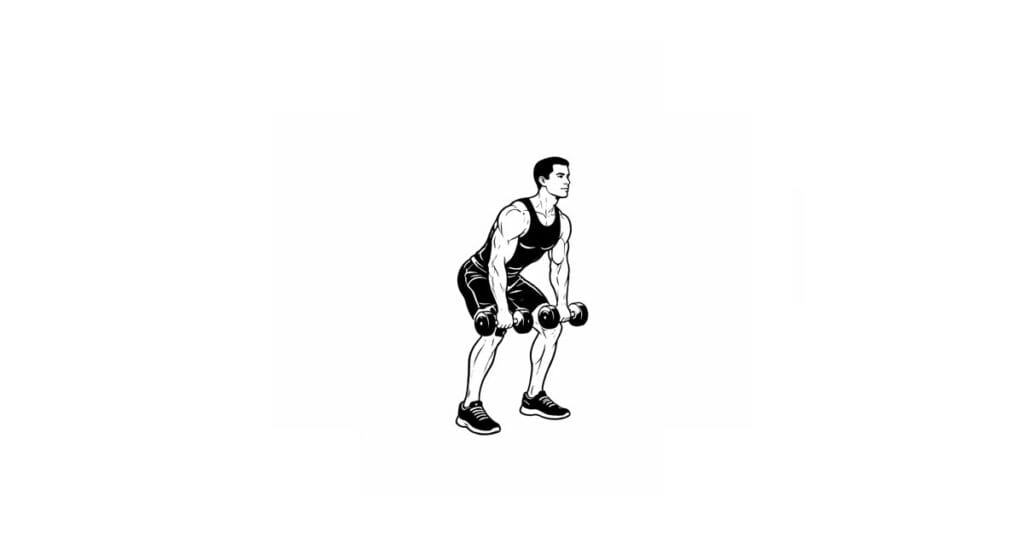
The Kettlebell Farmers Carry is a loaded walking exercise performed while holding a kettlebell in each hand at the sides of the body. It is a simple full-body strength exercise that challenges grip strength, core stability, posture, and the ability to maintain control while walking under load. The forearms, traps, upper back, shoulders, core, glutes, quads, hamstrings, and calves all contribute to maintaining body position and supporting efficient movement.
To perform the Kettlebell Farmers Carry, place two kettlebells on the floor beside your feet. Stand approximately hip-width apart and position yourself evenly between the weights. Push your hips backward, bend your knees slightly, and reach down to grip one kettlebell in each hand. Keep your spine neutral and your abdominal muscles braced as you prepare to stand.
Drive through your feet and extend your hips and knees to lift the kettlebells from the floor. Stand tall with your arms extended naturally beside your body. The kettlebells should hang close to your thighs without resting against them excessively. Keep your wrists relatively neutral and maintain a secure grip around each handle.
Before walking, establish a strong upright posture. Keep your head neutral, chest controlled, shoulders level, and core braced. Avoid aggressively pulling the shoulders backward or shrugging them toward your ears. The shoulders should remain stable while the arms hang naturally beneath them.
Begin walking forward with controlled, natural steps. Maintain a steady pace rather than rushing. Your feet should contact the ground in a comfortable walking pattern while your hips and knees move naturally. Keep the kettlebells close to your sides and minimize unnecessary swinging as you move.
The grip is one of the major challenges of the Kettlebell Farmers Carry. The forearms and hands must continuously produce enough force to prevent the kettlebells from slipping. Maintain a firm grip while keeping the wrists aligned with the forearms. Avoid allowing the wrists to bend excessively as fatigue develops.
The upper back and traps help support the shoulder girdle while the kettlebells pull downward. Maintain a stable shoulder position without allowing the upper body to collapse forward. At the same time, avoid constantly shrugging the shoulders upward. The goal is a strong but natural position that can be maintained while walking.
Core stability is another important component of the exercise. The weight hanging on both sides creates downward forces that the trunk must resist while the body moves. Brace the abdominal muscles and keep the torso upright. Avoid excessive arching through the lower back, leaning forward, or rocking from side to side with each step.
The lower body also works continuously during the carry. The glutes, quads, hamstrings, and calves help support the added load and produce each walking step. Maintain controlled foot placement and avoid taking steps that are so long that they disrupt your balance or posture. The walking pattern should remain smooth even while carrying the additional resistance.
Breathing should remain controlled throughout the exercise. Core bracing does not require holding your breath for the entire carry. Maintain abdominal tension while continuing to breathe naturally. If breathing becomes difficult because the torso is excessively rigid, reduce unnecessary tension while preserving a stable trunk position.
A common mistake is allowing the kettlebells to swing significantly forward and backward. Excessive swinging can alter balance and make the weights more difficult to control. Keep your arms relatively quiet and allow only the small amount of natural movement needed for comfortable walking.
Another common mistake is losing posture as grip fatigue develops. The shoulders may begin to round, the torso may lean forward, or the walking pattern may become unstable. Maintain the same body position from the beginning of the carry until the weights are safely returned to the floor. If the kettlebells can no longer be controlled securely, stop the carry rather than allowing technique to deteriorate.
When finishing the exercise, slow down and come to a complete stop. Avoid dropping the kettlebells while still moving. Once stable, push your hips backward and bend your knees as needed to lower the weights toward the floor. Maintain a neutral spine and keep the kettlebells controlled until they are fully supported by the ground.
The Kettlebell Farmers Carry differs from a single-arm suitcase carry because the load is held on both sides of the body. This creates a relatively symmetrical loading pattern while still demanding substantial grip and trunk stability. The bilateral load allows the exercise to emphasize total-body posture and loaded walking without intentionally creating a large side-to-side imbalance.
Overall, the Kettlebell Farmers Carry is a straightforward full-body strength exercise that develops grip endurance, upper-back stability, core control, lower-body strength, and loaded walking ability. Although the movement appears simple, maintaining strong posture while carrying resistance requires coordinated effort throughout the body. When performed with a secure grip, upright torso, stable shoulders, braced core, controlled steps, and safe pickup and set-down technique, the Kettlebell Farmers Carry provides an effective way to build practical full-body strength and carrying capacity.