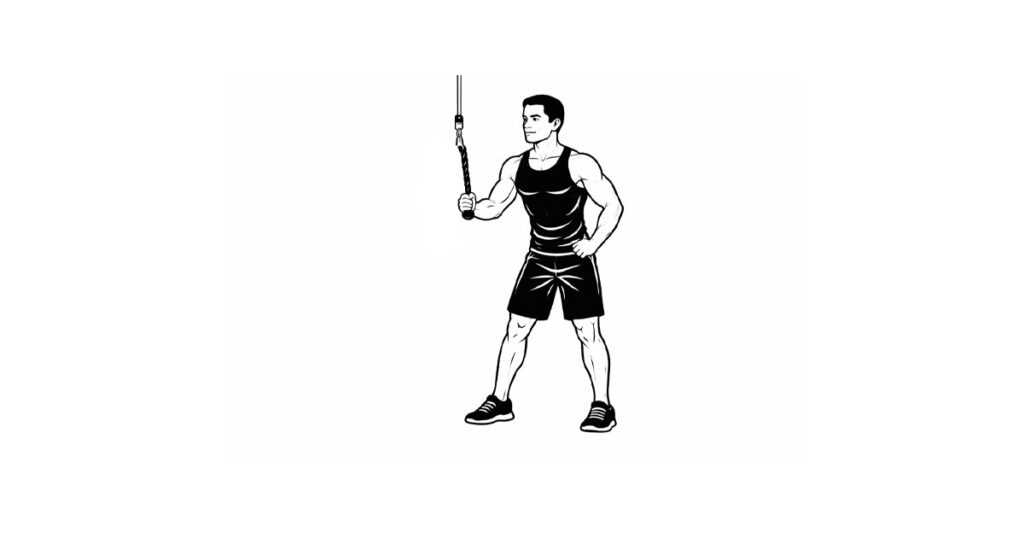
The Cable One Arm Pushdown is a unilateral triceps isolation exercise that emphasizes precise muscle control and balanced arm development. Performed with a cable machine, this movement keeps constant tension on the triceps, making it an effective option for improving strength, definition, and coordination.
The primary muscle targeted is the triceps, which are responsible for elbow extension. The shoulders and core act as stabilizers, helping keep the upper arm and torso steady throughout the movement. Because the exercise is performed one arm at a time, each triceps works independently, making it easier to identify and correct side-to-side strength imbalances.
Using a cable machine provides consistent resistance through the entire range of motion. Unlike free-weight variations, where tension can decrease at certain points, the cable maintains load from the top of the movement to full extension. This continuous resistance increases time under tension and promotes more effective triceps activation.
The single-arm design also improves mind-muscle connection. Focusing on one arm at a time allows greater awareness of triceps contraction and control, which can lead to improved technique and better long-term development.
Proper setup is essential for effectiveness and safety. Positioning the pulley at a high setting aligns the resistance with the natural downward pressing motion of the arm. Keeping the elbow close to the torso minimizes shoulder involvement and ensures the triceps remain the primary movers.
During execution, the movement should occur only at the elbow joint. The upper arm stays fixed while the forearm presses the handle downward under control. This strict isolation is key to targeting the triceps effectively and avoiding assistance from the chest or shoulders.
At the bottom of the movement, the arm should be nearly straight. Fully extending the elbow without forcefully locking it maximizes triceps engagement while reducing joint stress. A brief pause at full extension reinforces control and contraction.
The return phase should be slow and controlled. Allowing the handle to rise gradually keeps the triceps under tension and strengthens the muscles eccentrically. Letting the weight pull the arm back too quickly reduces effectiveness and increases strain on the elbow joint.
Maintaining an upright posture with a braced core helps prevent unwanted body movement. Leaning forward, rocking the torso, or using momentum shifts stress away from the triceps and compromises form.
This exercise is suitable for beginners due to its simple movement pattern and adjustable resistance. It is equally useful for more advanced lifters looking to refine triceps symmetry, incorporate unilateral work, or reduce joint stress compared to heavier bilateral pressing exercises.
Overall, the Cable One Arm Pushdown is a reliable and joint-friendly exercise for isolating the triceps, improving arm balance, and developing controlled pressing strength through a full range of motion.