
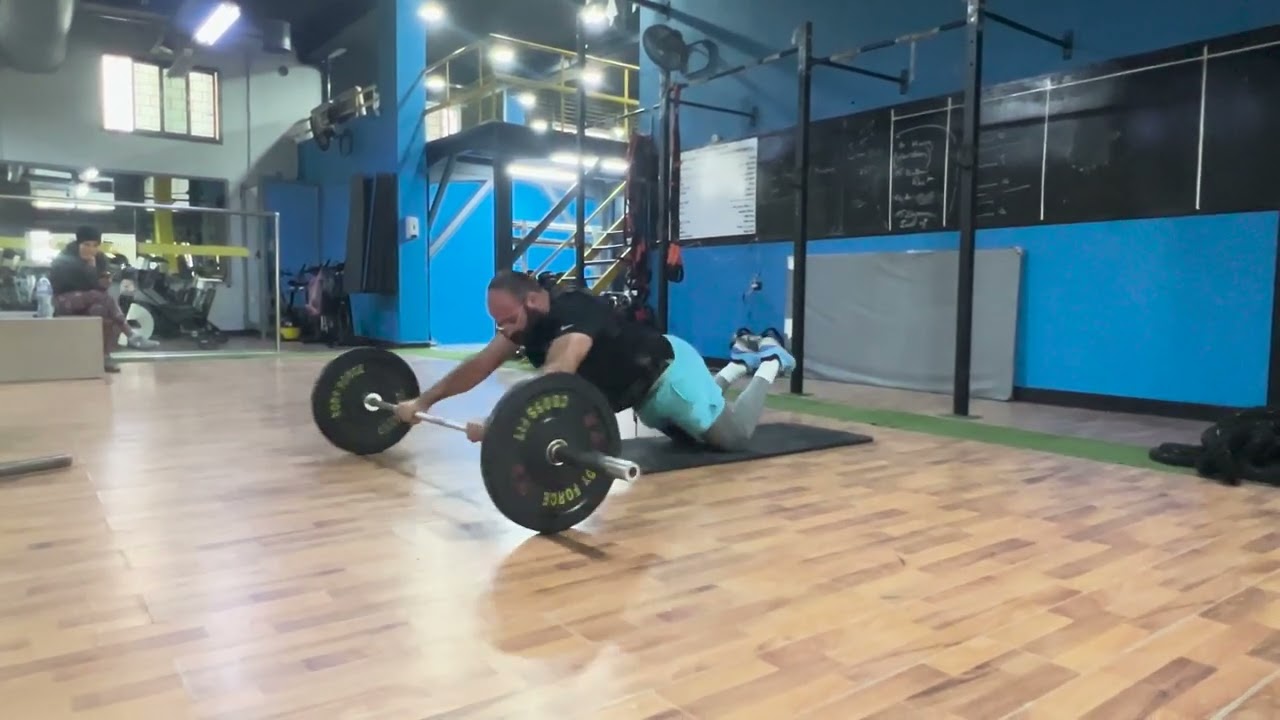
The Barbell Rollout is a challenging core strength exercise that primarily targets the abdominal muscles while engaging the obliques, shoulders, lats, triceps, chest, and glutes. Performed from a kneeling position, the exercise involves rolling a barbell forward along the floor while maintaining a stable spine and controlled hip position. The movement emphasizes anti-extension strength, meaning the abdominal muscles must resist excessive arching of the lower back as the body extends forward.
Unlike traditional abdominal exercises such as crunches or sit-ups, the Barbell Rollout challenges the core primarily through stabilization rather than repeated spinal flexion. As the barbell moves farther away from the knees, the resistance acting on the torso increases. The abdominal muscles must work harder to maintain proper alignment and prevent the lower back from collapsing into excessive extension.
To perform the Barbell Rollout, begin by loading a barbell with round weight plates that allow it to roll smoothly across the floor. Secure the plates with appropriate collars and position the barbell on a flat, non-slip surface. Kneel behind the barbell with your knees approximately hip-width apart and grip the bar slightly wider than shoulder-width using an overhand grip.
Position your shoulders approximately above the barbell and keep your arms extended with a slight natural bend at the elbows. Engage your abdominal muscles and glutes while maintaining a neutral spine. Keep your ribs aligned with your pelvis and avoid excessive arching through your lower back before beginning the movement.
Initiate the rollout by slowly pushing the barbell forward. Allow your shoulders to move in front of your hands as your arms extend farther away from your body. Your torso will gradually lower toward the floor while your knees remain planted. Maintain control through your abdominal muscles and avoid allowing your hips to drop excessively.
Continue rolling forward until you reach the farthest position you can maintain without losing spinal alignment. The appropriate rollout distance depends on your abdominal strength, shoulder mobility, and ability to stabilize your pelvis. A shorter rollout performed with proper technique is more effective than extending farther while allowing the lower back to sag.
At the extended position, maintain tension through your abdominal muscles, shoulders, and glutes. Keep your arms relatively straight and your head aligned with your torso. Avoid relaxing your abdomen or allowing your chest and hips to collapse toward the floor.
Begin the return phase by contracting your abdominal muscles and pulling the barbell backward. Your shoulders and upper-body muscles assist with bringing the barbell toward your knees while your core maintains spinal stability. Keep the movement controlled and avoid rapidly lifting your hips to compensate for insufficient abdominal strength.
Continue rolling backward until your shoulders return approximately above the barbell. Maintain abdominal tension throughout the movement and reset your position before beginning another repetition. Each repetition should involve a smooth forward rollout followed by a controlled return to the starting position.
The rectus abdominis is one of the primary muscles involved in the Barbell Rollout. Rather than repeatedly bending the spine, this muscle works to resist excessive lumbar extension as the arms move forward. The transverse abdominis and other deep abdominal stabilizers contribute to maintaining trunk stiffness and pelvic control.
The obliques assist with stabilizing the torso and preventing unwanted rotation or sideways movement. Because both hands grip the barbell, the exercise generally involves symmetrical loading, but the obliques remain active to maintain balanced trunk positioning.
The shoulders and lats contribute significantly to controlling the movement of the barbell. As the arms extend forward, these muscles help stabilize the shoulder joints and regulate the position of the upper body. The triceps assist with maintaining elbow extension, while the chest and upper-back muscles contribute to shoulder stability.
The glutes help stabilize the pelvis and maintain hip positioning throughout the rollout. Engaging the glutes can reduce the tendency to excessively arch the lower back as the body extends forward. This coordination between the abdominal muscles and glutes is important for maintaining controlled spinal alignment.
One of the defining characteristics of the Barbell Rollout is its adjustable difficulty. The farther the barbell moves away from the knees, the greater the challenge placed on the abdominal muscles. Beginners can perform shorter rollouts, while more experienced individuals can gradually increase the distance as their core strength and shoulder control improve.
A common mistake is rolling too far forward before developing sufficient abdominal strength. This often causes the lower back to sag and the pelvis to tilt excessively forward. Limit the rollout distance to the range where you can maintain abdominal tension and a stable spine.
Another common mistake is raising the hips excessively during the return phase. This reduces the demand on the abdominal muscles and changes the movement mechanics. Focus on bringing the barbell backward while maintaining controlled hip positioning rather than lifting your hips first.
Using momentum is another technique error. Rolling forward too quickly can make the extended position difficult to control, while rapidly pulling backward can reduce muscular engagement. Perform both phases deliberately and maintain consistent tension throughout the repetition.
The Barbell Rollout differs from the Ab Wheel Rollout primarily through the equipment used. Both exercises involve similar anti-extension mechanics, but the barbell provides a wider hand position and uses weight plates as rolling surfaces. The exact stability and rolling resistance depend on the barbell and plate configuration.
It also differs from the Plank because the Barbell Rollout introduces dynamic movement while maintaining anti-extension demands. As the barbell travels forward, the changing distance between the hands and knees increases the challenge placed on the abdominal muscles and shoulder stabilizers.
Overall, the Barbell Rollout is an effective exercise for developing abdominal strength, anti-extension control, shoulder stability, and full-body coordination. When performed with appropriate rollout distance, controlled movement, stable equipment, and consistent spinal alignment, it provides a demanding progression for strengthening the core.


