
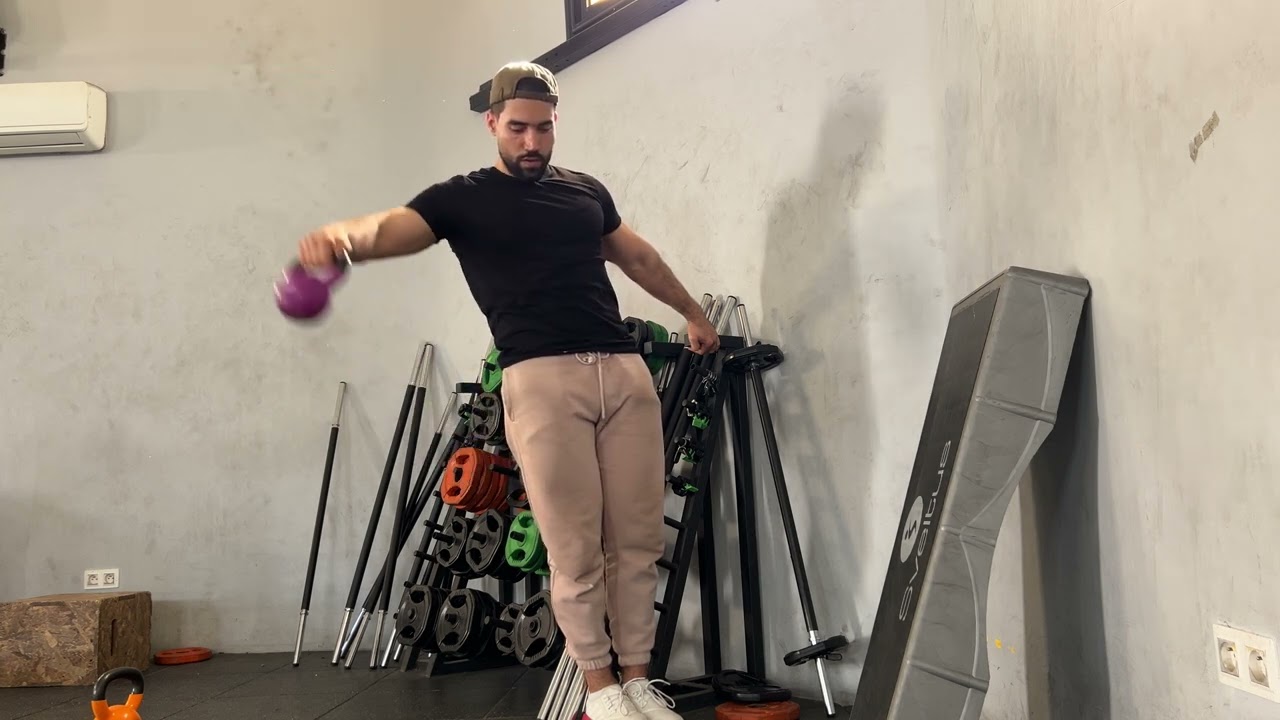
The Kettlebell Leaning Lateral Raise is a single-arm shoulder isolation exercise that emphasizes the lateral deltoids while challenging upper-body stability and control. The movement is performed by holding a sturdy support with one hand, leaning slightly away from it, and raising a kettlebell outward with the opposite arm. The shoulders are the primary muscle group involved, while the traps, upper back, core, obliques, and forearms assist with stabilization throughout the exercise.
The leaning position changes the angle of the working arm relative to gravity compared with a traditional standing lateral raise. This can increase the resistance experienced during portions of the movement and alter the strength demands throughout the range of motion. The exercise is particularly useful for training controlled shoulder abduction while maintaining a stable torso and consistent arm position.
To perform the Kettlebell Leaning Lateral Raise, stand beside a sturdy, stationary support. Hold the support securely with one hand and position your feet so you can lean slightly away without losing balance. Hold one kettlebell in your opposite hand with your arm resting naturally at your side. Keep your elbow slightly bent and maintain a controlled wrist position.
Before beginning, brace your abdominal muscles and establish a stable leaning position. Your body should remain relatively aligned rather than bending sharply at the waist. The supporting arm provides balance and allows you to maintain the intended angle while the working shoulder performs the lifting movement.
Begin by raising the kettlebell outward and slightly forward from your body. Lead the movement with your upper arm while keeping your elbow in a relatively consistent position. Allow your shoulder blade to move naturally as your arm rises, but avoid aggressively shrugging your shoulder toward your ear.
Continue lifting until your upper arm reaches approximately shoulder height or the highest position you can achieve comfortably without compensation. The exact range of motion depends on shoulder mobility, body position, and individual control. Avoid forcing the kettlebell higher if doing so requires excessive shoulder elevation, torso rotation, or loss of balance.
At the top of the movement, briefly maintain control of the kettlebell. Then lower the weight slowly along the same path until your arm returns toward your side. Maintain your leaning position throughout the lowering phase rather than allowing your torso to move toward the support. Complete the repetitions before changing sides.
The lateral deltoids are the primary muscles responsible for raising the arm away from the body. This action is known as shoulder abduction. The lateral deltoids contribute significantly to shoulder width and help control movements that require the arms to move outward from the torso.
The traps and upper-back muscles assist by controlling the shoulder blade as the arm rises. Proper shoulder blade movement is important because the shoulder joint and surrounding structures must work together during arm elevation. Allowing natural shoulder blade rotation supports comfortable movement without requiring excessive shrugging.
The core and obliques help maintain the leaning position and resist unnecessary torso movement. Because the body is positioned at an angle, these muscles contribute to stability while the working arm moves independently. The forearms and hands maintain a secure grip on the kettlebell and help control its position throughout the exercise.
One important difference between the Kettlebell Leaning Lateral Raise and a standard Kettlebell Lateral Raise is the body angle. In the standard variation, the torso remains upright while the arms move outward. In the leaning variation, the torso is inclined away from a support, changing the relationship between the arm and gravity. This can make different portions of the lifting motion feel more demanding.
The kettlebell also creates a different loading experience compared with a dumbbell. Because most of the kettlebell’s mass is positioned below its handle, the weight has an offset center of mass. This can influence wrist positioning, grip demands, and how the resistance feels during the raise. Maintaining a secure grip and controlled wrist position is important throughout the movement.
A common mistake is using excessive weight. The lateral raise places the resistance relatively far from the shoulder joint, creating substantial leverage even with a light kettlebell. Heavy resistance may encourage swinging, excessive elbow bending, or torso movement. Choose a kettlebell that allows the shoulder to perform the movement without unnecessary assistance.
Another common mistake is leaning too far away from the support. An excessive body angle can make it difficult to maintain balance and may increase the demands on the supporting arm. Use a comfortable lean that allows your feet to remain stable and your torso to stay controlled.
Avoid using momentum to raise the kettlebell. Swinging the arm or rotating the torso reduces the emphasis on controlled shoulder abduction. Keep the movement deliberate and focus on raising the upper arm outward rather than throwing the weight upward.
Elbow position should remain relatively consistent throughout the exercise. A slight bend is appropriate, but repeatedly bending and straightening the elbow changes the leverage and makes the movement less consistent. Maintain a comfortable elbow angle while allowing the shoulder to perform most of the lifting action.
Overall, the Kettlebell Leaning Lateral Raise is an effective shoulder isolation exercise for strengthening the lateral deltoids while developing upper-body stability, grip control, and coordination. When performed with a secure support, controlled leaning position, appropriate resistance, stable torso, and deliberate lifting and lowering phases, it provides a useful variation of the traditional lateral raise.


