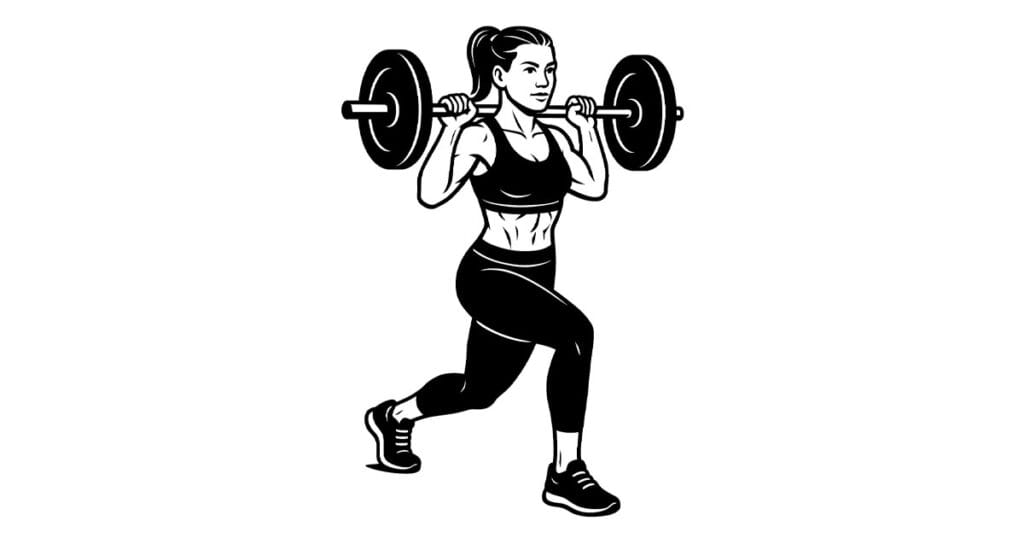
The Kettlebell Goblet Lunge is a unilateral lower-body strength exercise performed while holding a kettlebell at the chest in the goblet position. The exercise primarily targets the quads while also training the glutes, hamstrings, adductors, calves, core, and forearms. Because each repetition involves stepping into a split stance and controlling the body through a lunge, the movement also challenges balance, coordination, and single-leg stability.
To perform the Kettlebell Goblet Lunge, stand tall with your feet approximately hip-width apart. Hold one kettlebell securely with both hands at your chest. Keep the weight close to your torso rather than extending it forward. Brace your abdominal muscles, maintain a controlled rib position, and establish a stable upright posture before beginning.
Step forward with one foot into a comfortable lunge stance. The step should be long enough to create room for both knees to bend naturally without making the position difficult to control. Keep the front foot fully planted as your body transitions into the split stance.
Begin lowering by bending both knees. Allow the rear knee to travel downward toward the floor while the front knee bends over the front foot. Keep the front knee tracking in the same general direction as the toes. The knee may naturally travel forward depending on your proportions and ankle mobility, but the foot should remain stable throughout the movement.
Continue descending until you reach a comfortable depth. The rear knee can approach the floor, but it does not need to make contact. Maintain control of the kettlebell and avoid relaxing at the bottom. Your torso should remain stable, with only the amount of forward inclination that occurs naturally for your body proportions.
From the bottom position, drive through the front foot to begin returning to standing. Extend the front knee and hip while maintaining control of your balance. Push yourself backward until the front foot returns beside the other foot. Reestablish a tall standing position before performing the next repetition or changing legs.
The quads contribute significantly as the front knee bends and extends during each lunge. The glutes assist with hip extension as you push away from the floor, while the hamstrings and adductors contribute to hip stability and lower-body control. The calves help stabilize the ankles as you step, descend, and return to standing.
Holding the kettlebell in the goblet position increases the demand on the core. The abdominal muscles work to stabilize the torso and keep the load centered as your base of support changes. Keep the kettlebell close to your chest so the resistance remains easier to control. Allowing the weight to drift forward can increase the tendency to lean and may make balance more difficult.
Step length is an important part of proper Kettlebell Goblet Lunge form. A step that is too short can create a crowded position and make the movement uncomfortable, while an excessively long step can make it difficult to generate force and return to standing. Use a natural stride that allows both knees to bend comfortably while maintaining stable foot pressure.
A common mistake is allowing the front knee to collapse inward. Keep the knee aligned with the foot throughout the lowering and rising phases. The front heel should remain firmly planted rather than lifting as you descend. Maintaining full-foot contact provides a stable base from which to produce force.
Another common error is relying heavily on the rear leg. Although the rear foot contributes to balance, the front leg should perform much of the work needed to return to standing. Focus on driving through the front foot instead of aggressively pushing off the toes of the rear leg.
Postural control is also important. Avoid excessively arching the lower back or allowing the shoulders to round forward around the kettlebell. Keep your core braced, chest controlled, and shoulders stable. The head should remain generally aligned with the torso rather than looking excessively upward or downward.
The Kettlebell Goblet Lunge differs from a stationary split squat because each repetition includes a stepping component. This requires the body to transition from a symmetrical standing stance into a split stance and then return to the starting position. That transition increases the balance and coordination demands compared with remaining in one fixed stance.
The goblet position also differs from holding kettlebells at the sides. Keeping one kettlebell centered near the chest creates a front-loaded resistance that encourages active core stabilization and allows both hands to control the weight. The centered load can make it easier to focus on lower-body positioning while still adding meaningful external resistance.
Move through each repetition under control rather than using momentum. The forward step, descent, upward drive, and return to standing should each be deliberate. If balance is lost, reset your stance before continuing instead of attempting to complete the repetition from an unstable position.
Overall, the Kettlebell Goblet Lunge is an effective lower-body strength exercise for developing the quads, glutes, and supporting muscles while challenging core stability and coordination. When performed with a secure goblet grip, controlled step length, stable front foot, proper knee alignment, and smooth return to standing, the Kettlebell Goblet Lunge provides an effective way to develop unilateral lower-body strength and movement control.