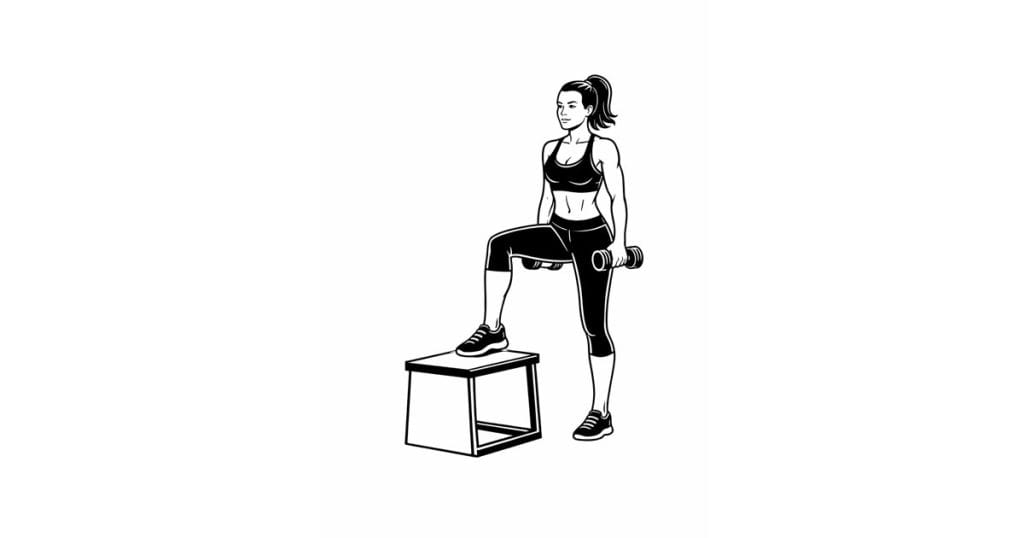
The Kettlebell Goblet Bulgarian Split Squat is a unilateral lower-body strength exercise performed with the rear foot elevated on a bench and a kettlebell held at the chest in the goblet position. The quads are the primary muscle group worked, while the glutes, hamstrings, adductors, core, calves, and forearms contribute to producing force and maintaining stability. Because most of the work is performed by the front leg, the exercise challenges each side of the lower body independently while also requiring balance and postural control.
To perform the Kettlebell Goblet Bulgarian Split Squat, stand a short distance in front of a stable bench while holding one kettlebell close to your chest with both hands. Support the kettlebell securely in the goblet position and keep your elbows comfortably positioned near your torso. Place the top of one foot on the bench behind you while the opposite foot remains firmly planted on the floor.
Your stance length is an important part of the setup. The front foot should be far enough from the bench that you can descend comfortably without losing balance, but it should not be positioned so far forward that the movement becomes awkward. Individual stance length will vary based on leg length, mobility, and comfort.
Before descending, brace your abdominal muscles and establish a stable torso. Keep the front foot fully planted and distribute pressure across the heel, forefoot, and outside edge of the foot. The rear foot provides support and balance, but the front leg should perform most of the work.
Begin the movement by bending your front knee and hip while allowing the rear knee to travel downward toward the floor. Think about lowering your body vertically rather than aggressively pushing forward. Maintain control of the kettlebell and keep it close to your chest throughout the descent.
Continue lowering until you reach a comfortable depth. The exact bottom position will vary depending on hip mobility, knee comfort, bench height, and individual body proportions. A deep range of motion can increase the challenge to the quads and glutes, but depth should never come at the expense of balance or controlled joint positioning.
Keep the front knee tracking in the same general direction as the toes. The knee can naturally travel forward during the movement, provided the foot remains stable and the position is comfortable. Avoid allowing the knee to collapse inward as you descend or stand.
From the bottom position, drive through your front foot and extend the knee and hip to raise your body. Maintain your balance as you return to the starting position. The rear leg should remain supportive without becoming the primary source of force. Finish in a stable split stance before beginning the next repetition.
The quads contribute significantly because the front knee moves through a substantial range of flexion and extension. The glutes assist with hip extension as you rise from the bottom position, while the hamstrings and adductors contribute to hip control and lower-body stability. The calves help stabilize the ankle and maintain consistent foot pressure.
Holding the kettlebell in the goblet position creates an additional demand on the core and upper body. The abdominal muscles work to stabilize the torso while the forearms and hands maintain control of the kettlebell. Keep the weight close to your body rather than allowing it to drift forward, which can make the exercise unnecessarily difficult to balance.
Torso angle can influence how the exercise feels. A relatively upright torso generally places substantial demand on the quads, while a modest forward torso inclination can increase hip involvement. Either position can occur naturally depending on body proportions and stance. The priority is maintaining a controlled spine and avoiding excessive rounding or arching.
A common mistake is relying too heavily on the rear leg. The elevated foot is primarily there to provide support and establish the split stance. Avoid aggressively pushing through the bench to rise. Focus on producing force through the front leg while using the rear leg primarily for balance.
Another common problem is an incorrect distance from the bench. Standing too close can create an uncomfortable, crowded bottom position, while standing excessively far away can make balance difficult. Adjust your front foot before beginning until you can descend smoothly while maintaining stable foot pressure.
The Kettlebell Goblet Bulgarian Split Squat differs from a standard split squat because the rear foot is elevated rather than planted on the floor. This changes the available range of motion and increases the stability demands placed on the working leg. The goblet-held kettlebell adds external resistance while keeping the load centered near the torso.
Balance is an important component of the exercise, but stability should not come from rushing through repetitions. Move slowly enough to maintain control during both the lowering and lifting phases. If your balance is lost, reset your stance before continuing rather than attempting to complete the repetition from an unstable position.
Overall, the Kettlebell Goblet Bulgarian Split Squat is an effective unilateral strength exercise for developing the quads, glutes, and supporting lower-body muscles while challenging balance and core stability. When performed with a secure goblet grip, stable front foot, controlled knee alignment, appropriate stance length, and smooth range of motion, it provides a highly effective way to develop single-leg lower-body strength and control.