
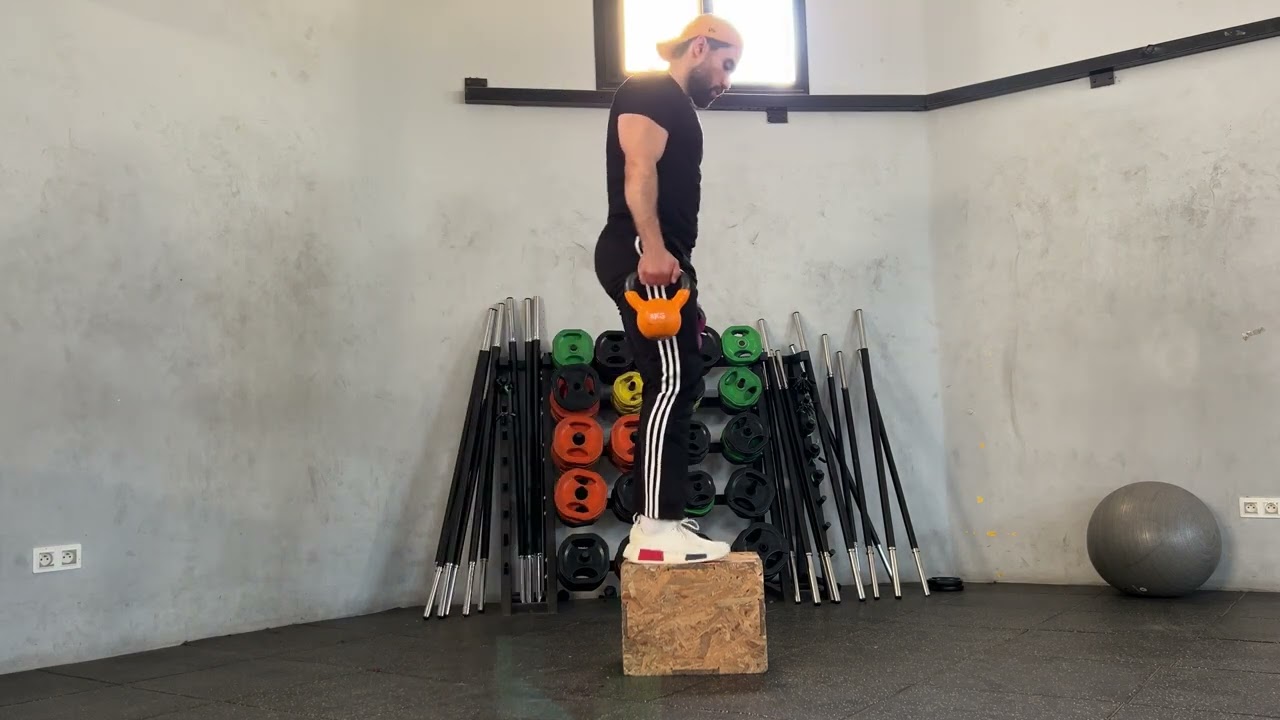
The Double Kettlebell Step-Up to Glute Kickback is an advanced unilateral lower-body strength exercise that combines a weighted step-up with a standing rear-leg hip extension. The movement is performed while holding one kettlebell in each hand and stepping onto an elevated platform. Once the athlete reaches the top, the free leg extends backward in a controlled glute kickback before returning to the starting position. The exercise primarily targets the glutes while also strengthening the quadriceps, hamstrings, calves, and supporting hip stabilizers.
Unlike a conventional Double Kettlebell Step-Up, which focuses on stepping onto and off an elevated platform, this variation adds a separate glute-focused movement at the top. The stepping leg performs the primary lifting action, while the free leg performs the backward hip extension. This creates a combination of unilateral strength, balance, coordination, and targeted glute engagement.
To perform the Double Kettlebell Step-Up to Glute Kickback, begin by selecting two kettlebells of equal weight and a sturdy exercise box. Stand facing the platform with your feet approximately hip-width apart. Hold one kettlebell in each hand with your palms facing inward and your arms hanging naturally beside your thighs. Maintain a neutral spine, brace your abdominal muscles, and keep your shoulders stable.
Place one foot fully on top of the box, ensuring that the heel and forefoot are securely supported. Keep your stepping knee aligned with your toes and maintain stable pressure through the elevated foot. Position your torso comfortably, allowing a slight forward inclination if necessary to move your center of mass over the supporting leg.
Initiate the step-up by pushing through the foot positioned on the box. Extend the knee and hip of the elevated leg to raise your body. Avoid pushing excessively through the trailing foot on the floor, as this reduces the relative contribution of the working leg. Keep both kettlebells hanging vertically beside your body without allowing them to swing.
Continue rising until you reach a stable standing position on the elevated leg. Rather than immediately placing the trailing foot onto the platform, keep it free and establish your balance. Maintain a slight natural bend in the supporting knee and keep your hips approximately level.
Once balanced, initiate the glute kickback by extending the free leg backward from the hip. Keep the moving knee straight or slightly bent and focus on contracting the gluteus maximus. The backward movement should be relatively small and controlled. Avoid lifting the leg so high that your lower back arches or your pelvis rotates.
Pause briefly at the end of the kickback before slowly returning the free leg beneath your hip. Maintain abdominal tension and stable shoulder positioning throughout the movement. After completing the kickback, lower the free foot toward the floor while bending the supporting knee and hip under control. Return to the starting position and repeat for the prescribed number of repetitions before switching legs.
The gluteus maximus is one of the primary muscles involved in the Double Kettlebell Step-Up to Glute Kickback. During the step-up, it contributes to hip extension as the athlete rises onto the platform. During the kickback, the gluteus maximus of the free leg actively extends the hip backward. This combination challenges the glutes through two distinct movement demands within the same repetition.
The quadriceps play an important role during the step-up portion. These muscles extend the knee during the ascent and control knee flexion during the descent. The amount of quadriceps involvement depends on factors such as platform height, knee angle, torso position, and the degree of assistance provided by the trailing leg.
The gluteus medius and other hip stabilizers help maintain pelvic alignment while the athlete balances on one leg. The adductors also contribute to hip stability, while the hamstrings assist with hip extension and lower-body control. The calf muscles help stabilize the ankle of the supporting leg throughout the movement.
The abdominal muscles and spinal stabilizers work to maintain torso positioning as the body moves onto the platform and the free leg extends backward. Because the athlete holds two kettlebells beside the body, the forearm muscles must maintain grip strength throughout the set. The upper-back muscles also assist with keeping the shoulders stable under load.
One of the main benefits of the Double Kettlebell Step-Up to Glute Kickback is its emphasis on unilateral glute strength. The supporting leg performs the step-up while the opposite leg completes the kickback. This allows both hips to experience different muscular demands during each repetition and encourages coordinated lower-body movement.
Another benefit is the additional balance challenge created by the kickback. A standard step-up can be completed by bringing both feet onto the platform, but this variation requires the athlete to remain balanced on one leg while moving the other leg backward. This increases the demands on the supporting hip stabilizers, ankle muscles, and trunk.
The exercise also provides an opportunity to train hip extension through different movement patterns. The step-up involves extending the hip and knee to raise the body, while the kickback isolates the backward movement of the free leg more directly. Combining these actions creates a glute-focused exercise that can be incorporated into lower-body strength and functional fitness programs.
A common mistake is using momentum to swing the free leg backward. This reduces control and may encourage excessive lumbar extension. Instead, move the leg slowly from the hip and focus on contracting the gluteus maximus without changing the position of your lower back.
Another common mistake is allowing the pelvis to rotate during the kickback. When the free leg moves backward, the athlete may turn the hip outward or allow one side of the pelvis to rise. Maintain approximately level hips and keep your pelvis facing forward to emphasize controlled hip extension.
Using excessive resistance can also compromise technique. Heavy kettlebells may make it difficult to establish balance at the top of the platform, causing the athlete to lean excessively or swing the weights. Begin with lighter resistance than you would use for a conventional step-up and increase the load only when the combined movement can be performed consistently.
Platform height is another important consideration. A higher platform increases the range of motion required during the step-up but may also make the single-leg balance and kickback more difficult. Choose a height that allows the athlete to maintain controlled knee alignment and stable pelvic positioning throughout the exercise.
The Double Kettlebell Step-Up to Glute Kickback differs from the standard Double Kettlebell Step-Up because the free leg performs an additional hip-extension movement at the top. It also differs from a standing kettlebell glute kickback because the resistance is held in the hands rather than attached directly to the moving leg. The kettlebells primarily increase the loading demands of the step-up and the stabilization requirements of the supporting leg, rather than directly resisting the backward kickback movement.
For beginners, the movement can be introduced without kettlebells. Practicing a bodyweight step-up followed by a controlled rear-leg extension allows the athlete to develop balance and coordination before adding external resistance. Once the combined movement is comfortable, lightweight kettlebells can be introduced gradually.
More experienced individuals can incorporate the Double Kettlebell Step-Up to Glute Kickback into glute-focused workouts, unilateral lower-body strength sessions, and functional training circuits. It works particularly well as an accessory exercise after squats, deadlifts, or other compound lower-body movements. Moderate repetitions performed with controlled tempo are generally more appropriate than explosive movements or maximal loading.
Overall, the Double Kettlebell Step-Up to Glute Kickback is an effective exercise for developing glute strength, unilateral leg control, balance, and coordination. When performed with a stable platform, secure kettlebell grip, controlled step-up, and deliberate rear-leg hip extension, it provides a challenging addition to a comprehensive lower-body training program.


